Solar and battery installation in Bungendore
Bungendore is on the Essential Energy network, which runs a different timetable and different export ranges from the Sydney distributors. It also has the highest battery rate of any suburb on this site.
Solar in Bungendore: the highest battery rate on the record
Bungendore carries ten completed Crown Solar installations, six of them with a recorded system size. The median is 13.9kW and the range runs from 11.4kW to 29.9kW. Both figures sit above the Sydney suburbs on this site, and the bottom of the Bungendore range is above the median of several of them.
The more striking number is the battery rate. Seven of the eight Bungendore jobs with a recorded system type are solar paired with a battery. The highest proportion of any suburb Crown Solar works in. That is not a sales pattern, it is the conditions: rural supply at the end of long feeders, a cold-climate winter evening load, and properties where losing power means losing the water pump as well as the lights.
Postcode 2621 covers more than the town itself, taking in Bywong, Forbes Creek, Hoskinstown, Primrose Valley, Anembo and Rossi, so "Bungendore" here means a spread of rural and semi-rural properties rather than a single streetscape.
Your grid connection: Essential Energy, postcode 2621
Bungendore is on the Essential Energy network, which covers regional New South Wales. It is neither Ausgrid nor Endeavour Energy, and that distinction does real work here, because Essential runs its own timetable, its own export ranges and its own equipment list.
Flexible exports reach 2621 on 22 February 2027
Essential Energy began its postcode-by-postcode rollout of the emergency backstop and flexible exports on 23 November 2026, but that is the network-wide start date, not Bungendore's. On Essential's published postcode rollout, postcode 2621 has a date of 22 February 2027. The last of Essential's three groups.
That distinction matters on a quote. Essential states that applications submitted and approved before the rollout reaches a postcode follow the existing connection process, and fixed export limits apply. So a Bungendore system connected now is connected under the existing arrangement rather than the flexible one, and a quote describing a flexible range without noting the February date has described a connection you cannot yet have.
This is not an argument against installing now, since most of the value of a system is in the energy you use yourself rather than the energy you export. It is an argument for having the position stated in writing. Essential publishes a postcode checker, and that is the place to confirm the date for your own address rather than taking a general figure from a web page.
The export arrangement itself differs from Endeavour's in a way worth understanding. Rather than a single flexible figure, solar retailers on the Essential network can select a flexible range of either 1.5kW to 5kW or 1.5kW to 10kW per phase. Which range your installer selects is a decision made on your behalf, and it is a reasonable thing to ask about before you sign, because it sets the ceiling on what your system can send to the grid.
Flexible export limits on Essential are not mandatory. You can choose a low fixed limit instead, and existing systems are not automatically moved across. Flexible limits apply to new and upgraded systems, up to and including 200kW.
Equipment: a supported list, not just a standard
To be backstop-enabled on Essential Energy, a system needs CSIP-AUS compliant equipment meeting SA TS 5573:2025, and it has to be supported by Essential Energy. That second condition is the one to watch. Compliance with the standard is not by itself enough; the device also has to appear on Essential's own supported list.
It is worth asking an installer to confirm, in writing, that the specific inverter model they are quoting is on that list. A model that is fine on another network is not automatically fine here, and discovering it at commissioning is an expensive way to find out.
What Bungendore properties mean for system design
Cold, and genuinely cold. Bungendore sits on the Southern Tablelands at altitude, and its winter is nothing like Sydney's. Overnight frosts are routine. The practical consequences are a winter evening load dominated by heating, and a solar yield curve with a much deeper winter trough than a coastal site. A system sized against summer performance will disappoint in July, which is precisely when the household needs it most. This is the single biggest reason the local battery rate is what it is.
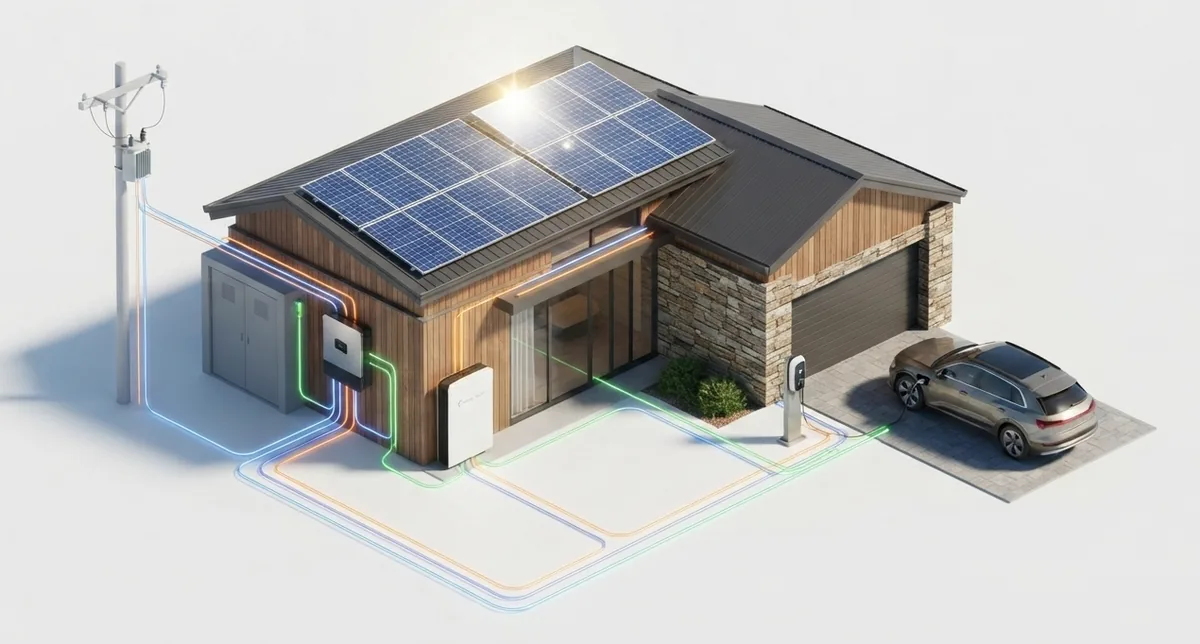
Rural supply and what an outage actually costs. On a rural property, mains power runs the water pump, and often the septic system and the shed as well. An outage is not an inconvenience, it is no water. Whether a battery provides genuine backup, and what it is wired to carry during an outage, is a specific design question rather than a feature on a brochure, and it is worth insisting on a clear answer about which circuits stay live.
Pumps and motor loads. Bore and pressure pumps, workshop equipment and occasionally irrigation all draw heavy starting currents. The battery conversation has to cover what the inverter can actually start, not only how many kilowatt hours it stores. Quotes written for suburban houses routinely miss this.
Large roofs, sheds and outbuildings. Roof area is rarely the limiting factor. Sheds are often a better mounting location than the house, depending on structure, supply arrangement and cable run. Sub-boards are common and affect where the inverter goes.
The panel Crown Solar is currently installing is Trina Solar, in its high-wattage Vertex range. On the Bungendore record the existing roofs are led by Jinko Solar, with AE Solar close behind, which describes what was being fitted in earlier years rather than what appears on a quote today. AE Solar's hot-spot-free construction suits roofs with partial shading, and on rural properties with established trees around the house that remains a live consideration worth raising. Crown Solar also installs JA Solar, AE Solar and LONGi panels.
Bushfire, and why it belongs in the quote
Much of the 2621 area is bushfire-prone land, and that is not a formality in this part of New South Wales. It affects the planning position, since a proposal on bushfire-prone land may fall outside the exempt development pathway and require consent, and it affects the installation itself.
Most rooftop solar in NSW is exempt development under State Environmental Planning Policy (Transport and Infrastructure) 2021 and needs no development application, provided every condition is met, including a capacity limit and a restriction on street-facing panels. Whether your lot is mapped as bushfire-prone is checked against Queanbeyan-Palerang Regional Council mapping before a quote is finalised, not assumed.
It also bears on where equipment is mounted and how cabling is run, and on the practical question of isolation during an emergency. These are worth discussing on site.
Batteries in Bungendore
With seven of eight recorded jobs including storage, the battery is the system here rather than an addition to it, and the sizing logic shifts accordingly.
In a Sydney suburb a battery is usually sized to cover the evening peak and get the household to morning. On a Bungendore property with a winter heating load and a water pump, the question is often closer to how long you want to ride through an outage and which circuits matter. Those are different questions and they produce different answers, sometimes a larger battery and sometimes a differently wired one rather than a bigger one.
Your own twelve months of bills, and an honest account of what you want backed up, settle it better than any rule of thumb. The federal battery discount is applied by the installer at the point of sale through the small-scale certificate mechanism and steps down over time, so Crown Solar sets out the figure applying to your quote in writing rather than publishing one here.
What the installation actually involves
Site assessment. Roof structure on house and sheds, winter shading and winter yield, supply arrangement and sub-boards, pump and motor loads, which circuits you want backed up, and internet coverage at the inverter.
Design and quote. Layout, equipment confirmed as supported by Essential Energy, and which flexible export range has been selected.
Connection application to Essential Energy. Nothing is installed before approval comes back.
Installation. A rural job with storage and sub-board work runs longer than a suburban day.
Commissioning, metering and handover paperwork.
Find out what your roof can carry
The design starts with your roof and your own bill, not with a number over the phone.
Crown Solar does not quote off a template or over the phone. Every design is built on your own site data.
Common questions about solar in Bungendore
Are the Endeavour Energy dates relevant to me?
No. Those are Endeavour's rollout stages for Sydney and the surrounding region. Bungendore is on Essential Energy, whose rollout began 23 November 2026 and runs to early February 2027. Essential's postcode checker gives the date for 2621.
Will a battery keep my water pump running in an outage?
It can, but only if the system is designed and wired for it, and only within the battery's capacity. Ask specifically which circuits remain live during an outage and get the answer in writing. It is the question most worth asking on a rural property.
Does the cold damage the panels?
No. Panels are more efficient in cold conditions than hot ones. The winter issue is shorter days and a lower sun angle, not temperature, and it is a yield question that belongs in the design rather than a durability one.
What to check in any Bungendore quote
Four questions matter more here than they would on a suburban roof, and the last one is the one most often skipped.
- That the inverter is on Essential Energy's supported list. CSIP-AUS compliance alone is not enough on this network. Ask for confirmation of the specific model in writing.
- Which flexible export range has been selected. 1.5kW to 5kW, or 1.5kW to 10kW per phase. Your installer chooses it on your behalf, and it sets the ceiling.
- Whether the quote accounts for winter rather than annual average yield. A Southern Tablelands winter is the test of the system, and an annual figure hides it.
- Which circuits stay live during an outage. On a property where mains power runs the water pump, this is the difference between a battery that solves your real problem and one that only reduces a bill.
Talk to Crown Solar about your Bungendore property
Crown Solar is a NSW electrical contractor, licence 378172C, and a New Energy Tech Approved Seller, working across New South Wales and the ACT. The office is at 3B/4 Louise Avenue, Ingleburn, open Mon–Fri 9am–5pm.
Call 1800 38 50 38, email info@crownsolar.com.au, or use the contact form.
Get it in writing for your Bungendore address
Send the address and your last four quarterly bills. You get a system size, the roof faces it sits on, the export arrangement, and the price. All in writing.
Prefer email? info@crownsolar.com.au. One question to start with: what is your place using in a quarter?