Solar and battery installation in Carlingford
Carlingford looks like Ausgrid territory and is not. Its own meter records show Endeavour. That changes the export rules, and mature canopy decides the rest.
Solar in Carlingford: not the network you would guess
Carlingford accounts for three completed Crown Solar installations. One carries a usable recorded system size, at 11.0kW, and the record includes a battery of 20.0kWh. One size record is not a local figure and this page will not present it as one.
The useful fact here is a network one, and it catches people out. Carlingford is on Endeavour Energy, not Ausgrid. Sitting where it does in Sydney's north-west, between Parramatta and the Hills, most people assume Ausgrid, and plenty of published guides would tell you the same. The Carlingford job on Crown Solar's record that carries a meter identifier shows an Endeavour network prefix.
That matters because the two networks have entirely different export arrangements and entirely different timetables. Confirm it from your own meter identifier rather than taking it from this page or from anyone's guess, because the boundary between the two runs through this corridor and a quote prepared against the wrong network will have the wrong rules in it.
Carlingford mostly falls within the City of Parramatta, and reaches the Hornsby Shire boundary, so the council is confirmed against the lot rather than assumed from the suburb.
Your grid connection: Endeavour Energy, postcode 2118
Endeavour approves the connection and sets the export limit. Your electricity retailer does neither.
Where 2118 sits in Endeavour's rollout
Endeavour stages flexible exports by postcode, not by council.
-
Stage 1, commenced 2 November 2026 Postcodes in and around the Campbelltown, Camden, Picton and Liverpool regions.
-
Stage 2, commences 30 November 2026 A further set of postcodes across Endeavour's area.
-
Phase 3, February 2027 Endeavour has published the month and not a day within it. Its rollout map gives the date for a specific address. Postcode 2118 is in this stage
What you may export, by connection type
Endeavour Energy, kilowatts per phase.
Flexible exports reach 2118 in the February 2027 phase
Endeavour has published two rollout stages by postcode. The first commenced on 2 November 2026, covering postcodes in and around the Campbelltown, Camden, Picton and Liverpool regions. The second commences on 30 November 2026 and adds a long list of Blue Mountains, Penrith, Hawkesbury and Illawarra postcodes. 2118 appears in neither, which places Carlingford in the February 2027 phase of Endeavour's availability plan. Endeavour has published the month, not a date within it, so this page gives the month and nothing more precise. Treat any quote that names a specific February day for 2118 as unsourced.
When it applies, a flexible export connection allows up to 10kW per phase to be exported most of the time, reduced only when local grid conditions require it. The opt-out is Endeavour's Fixed Exports plan with a maximum export of 1.5kW. Until the rollout reaches 2118, an application submitted and approved under the existing process carries a fixed export limit, and that position should appear on your quote in writing.
What your system has to meet
Endeavour requires an address in its network area, an active internet connection by Wi-Fi or cable, net export metering configured for the solar inverter, and a CSIP-AUS approved inverter listed on the Clean Energy Council website.
On a large Carlingford block the internet requirement deserves a thought. Where the meter box and the house are a long way apart, or the inverter would sit in a detached garage, the signal at the inverter position is the thing to check rather than the signal in the kitchen. It is a connection requirement, not an optional extra.
The emergency backstop mechanism allows the network to curtail exports when the grid cannot absorb what is being sent into it. Endeavour describes it as a last resort, expected to be used rarely and for short periods.
Mature canopy is the dominant design constraint
Carlingford's established streets carry substantial tree cover on generous lots, much of it on the blocks themselves rather than only on the verge. On a solar design that is the single biggest variable here, and it is routinely underestimated.
It is a winter problem, not a summer one. A tree that casts nothing on the roof in January can cover a third of an array at nine in the morning in June, because the sun is roughly thirty degrees lower. So shading is assessed for the winter sun path, not from how the roof looks on the day of the visit, and an installer who glances at an aerial image in February has not assessed it.
Partial shade costs more than its own share. Shade across part of a string pulls down more output than the shaded area alone would suggest, which is why the panel layout and the electrical design have to answer the shading pattern together. Where a roof is genuinely broken up by shade, string arrangement and in some cases per-panel or per-string optimisation is a design response rather than an upsell. Ask how the design handles it, because the answer tells you whether the layout was thought about or copied.
Tree work is a council matter. The City of Parramatta regulates removal and significant pruning of trees, and permission is required in many cases. The honest sequence is to design around the canopy you have and to treat pruning as a separate application you may or may not get, rather than as an assumption baked into a yield figure.
And sometimes the honest answer is a smaller array. Adding panels to a shaded face can return less than it costs. A smaller array on the clear faces, with storage sized against evening use, is frequently the better purchase on a heavily treed Carlingford block, which is a conversation worth having before a number is quoted.
What else Carlingford properties mean for system design
Larger lots, and often additions. A Carlingford house has frequently been extended once or twice, leaving roof planes at different pitches and materials meeting at awkward junctions. The usable area is smaller than the roof looks, and the array ends up split across more faces than a simple roof needs.
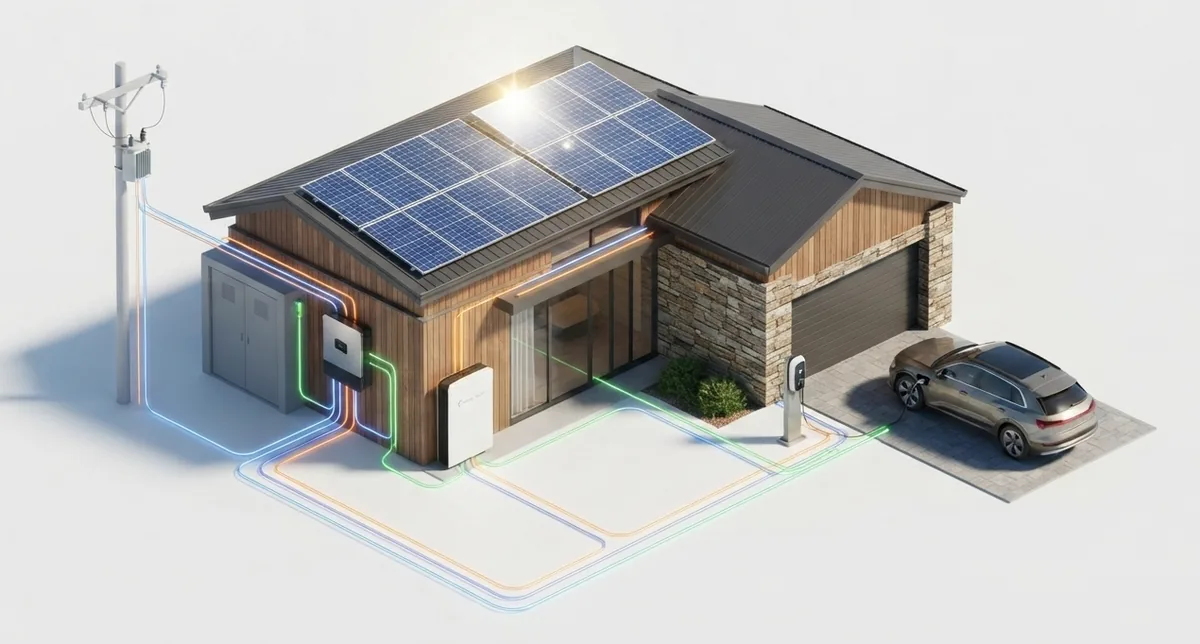
Roof condition and material. Concrete and terracotta tile are both common, and tiles of real age are brittle, so the mounting method and the number of tiles lifted matter. Where a roof is close to needing replacement, doing the roof first and the solar second is cheaper than paying to remove and refit an array later. The roof is assessed at quote stage.
Switchboard age. Established housing here commonly needs switchboard attention before a battery, in capacity, protective devices and physical space. It should be assessed and priced before you sign rather than raised on installation day.
Asbestos in a pre-1990 house is a constraint to plan for. Bonded asbestos cement sheeting was used in Australian housing until the late 1980s, including eaves linings and meter box backing boards. Where it is present it changes how cable is run and who may do that work. The eaves and meter box are inspected during the assessment rather than discovered with a drill.
Three-phase supply is reasonably common on larger homes here, and since the flexible export allowance applies per phase, that changes the sizing arithmetic once the rollout arrives. Confirm your supply type before comparing quotes.
Batteries in Carlingford
A battery is sized against evening and overnight consumption, not against the size of the array. The useful figure is what the household actually uses after dark, which your bills and meter data answer better than any estimate.
On a shaded block storage is often the better of the two purchases, because where the roof cannot carry a larger array, energy you store and use yourself is worth the retail rate you avoid paying rather than the feed-in rate you do not control. The 20.0kWh battery on the local record is real capacity, and it is not a benchmark for an average household.
A smaller battery that is actually cycled every day beats a large one that is rarely emptied. Where a battery is being retrofitted, the inverter decides most of the cost: adding storage is treated as an upgrade, which brings the connection under current requirements, so an inverter that is not CSIP-AUS approved turns an addition into a replacement plus an addition.
The federal battery discount is applied by the installer at the point of sale through the small-scale certificate mechanism, and the rate steps down over time. Crown Solar sets out the figure applying to your quote in writing rather than publishing one here.
Approvals: the City of Parramatta and the NSW planning rules
For most rooftop installations the council is not the approval authority, because most rooftop solar in NSW is exempt development under State Environmental Planning Policy (Transport and Infrastructure) 2021 and requires no development application.
The exemption is conditional, with a capacity limit and a restriction on panels facing the street among the conditions, and a proposal that does not meet every one of them requires development consent instead. It also carries limits on land with heritage significance, and the City of Parramatta maintains a heritage schedule and conservation areas across its older streets. Since Carlingford reaches the Hornsby Shire boundary, the relevant council's mapping is the one that applies, and that is settled from the lot. Crown Solar checks it before the quote is finalised.
What the installation actually involves
Network and council established first, from the meter identifier and the lot, because the export rules and the mapping checks follow from them.
Site assessment. Roof type, pitch, age and condition across every plane, usable faces, and the winter shading pattern measured rather than estimated.
Switchboard, meter box and eaves. Capacity, protective devices, and whether pre-1990 sheeting is present.
The existing system, if there is one. Make, model and age of the inverter, and whether it is battery-capable.
Design and quote. Layout by roof face with the string design stated, battery sizing against overnight use, and the export arrangement that applies given the February 2027 phase.
Connection application to Endeavour Energy. Nothing is installed before approval.
Commissioning, metering and handover paperwork.
Find out what your roof can carry
The design starts with your roof and your own bill, not with a number over the phone.
Crown Solar does not quote off a template or over the phone. Every design is built on your own site data.
Common questions about solar in Carlingford
Should I wait for February 2027?
Generally not. Most of the value of a solar system is in the energy you use yourself rather than the energy you export, and on a shaded block that is more true again. What you should insist on is the arrangement being stated in writing on the quote.
An installer told me Carlingford is Ausgrid. Does it matter?
It matters, and it is checkable in a minute from your meter identifier. If a quote names Ausgrid's arrangements for an Endeavour address, the export position in it is wrong, and it is fair to ask what else was assumed rather than looked up.
Is a big array worth it if I have heavy shade?
Not always, and this is where honest design pays. Adding panels to a shaded face can produce less than the cost suggests. A smaller array on the clear faces, with storage sized against evening use, is frequently the better outcome.
What Crown Solar installs here
The panel Crown Solar is currently installing is Trina Solar, fitted as the high-wattage Vertex range. On the local record Jinko Solar is the panel on the Carlingford roof on file, from the earlier years of this work. That distinction is worth having if you are comparing a quote today against what a neighbour had fitted: the panel on your quote is the current one, not the one on their roof. Crown Solar also installs JA Solar, AE Solar and LONGi panels.
Inverters and storage
GoodWe appears on the recorded Carlingford inverters.
Crown Solar also installs FoxESS, Sungrow, Fronius and SAJ inverters, and Tesla Powerwall, Sigenergy and AlphaESS batteries. On a shaded roof the inverter choice is partly a shade-management decision, so it is made with the layout rather than after it. Those are the current range, available on any job, not a list of what has been fitted locally.
Talk to Crown Solar about your Carlingford home
Crown Solar is a NSW electrical contractor, licence 378172C, and a New Energy Tech Approved Seller. The office is at 3B/4 Louise Avenue, Ingleburn, and is open Mon–Fri 9am–5pm.
For a quote on a Carlingford address, call 1800 38 50 38, email info@crownsolar.com.au, or use the contact form.
Get it in writing for your Carlingford address
Send the address and your last four quarterly bills. You get a system size, the roof faces it sits on, the export arrangement, and the price. All in writing.
Prefer email? info@crownsolar.com.au. One question to start with: what is your place using in a quarter?