Solar and battery installation in Cranebrook
Cranebrook sits in the hottest part of the Sydney basin, and heat costs output from both panels and inverters. That is a design question, not a disclaimer, and it changes where the inverter goes.
Solar in Cranebrook: designing for the hottest part of Sydney
Cranebrook accounts for four completed Crown Solar installations. Where a system size is recorded, the three figures on file are 12.2kW, 14.8kW and 14.8kW. Noticeably larger than the suburban average, though three records are not a local standard and this page does not present them as one.
What makes a Cranebrook page worth writing is the climate. Penrith recorded 48.9°C in January 2020, the highest temperature ever recorded in a Sydney suburb, beating the previous Sydney basin mark of 47.8°C set at Richmond in 1939. The World Meteorological Organization described it as the highest observed temperature on record in an Australian metropolitan area. Cranebrook sits in that same pocket at the foot of the Blue Mountains.
That is not a piece of trivia on a solar page. Heat costs you output, from the panels and from the inverter, and the losses are largest on exactly the days when demand is highest. A system designed for a coastal suburb and installed here will underperform its own numbers. The rest of this page is mostly about what to do about that.
Your grid connection: Endeavour Energy, postcode 2749
Cranebrook is in the Endeavour Energy distribution area. Endeavour approves the connection and sets the export limit. Your electricity retailer does neither.
Where 2749 sits in Endeavour's rollout
Endeavour stages flexible exports by postcode, not by council.
-
Stage 1, commenced 2 November 2026 Postcodes in and around the Campbelltown, Camden, Picton and Liverpool regions.
-
Stage 2, commences 30 November 2026 A further set of postcodes across Endeavour's area. Postcode 2749 is in this stage
-
Phase 3, February 2027 Endeavour has published the month and not a day within it. Its rollout map gives the date for a specific address.
What you may export, by connection type
Endeavour Energy, kilowatts per phase.
The second stage, not the first: 30 November 2026
Endeavour's rollout of flexible exports is staged by postcode, not by council. The first stage commenced on 2 November 2026 and covered postcodes in and around the Campbelltown, Camden, Picton and Liverpool regions. Postcode 2749 is in the second stage, commencing 30 November 2026, along with the other Penrith, Blue Mountains and Hawkesbury postcodes.
Endeavour states that applications submitted and approved before the rollout reaches a postcode follow the existing connection process, and fixed export limits apply. So a Cranebrook system connected in the weeks before 30 November is connected under the existing arrangement, and a quote describing a flexible export range without noting the date has described a connection you cannot yet have.
A flexible export connection allows up to 10kW per phase to be exported most of the time, reduced only when local grid conditions require it. The opt-out is Endeavour's Fixed Exports plan with a maximum export of 1.5kW, carrying the same connection requirements. On the 14.8kW systems that appear on the local record, 1.5kW is a severe restriction rather than a simplification.
What your system has to meet
Endeavour requires an address in its network area, an active internet connection by Wi-Fi or cable, net export metering configured for the solar inverter, and a CSIP-AUS approved inverter listed on the Clean Energy Council website.
Larger systems carry a further consideration. Streamlined approval pathways apply up to certain inverter capacity thresholds, and above those a proposal can require a more detailed network assessment, which takes longer and may carry a cost. At the sizes recorded locally that threshold is worth checking before equipment is ordered rather than after.
The emergency backstop mechanism allows the network to curtail exports when the grid cannot absorb what is being sent into it. Endeavour describes it as a last resort, expected to be used rarely and for short periods.
Heat: what it actually does to a system
This is the section worth reading if you live anywhere in the Penrith basin.
Panels lose output as they get hot. A panel's rated output is measured at a cell temperature of 25°C, and output falls as the cell rises above that. On a roof in western Sydney the cell runs well above the air temperature, because the panel is sitting in full sun on a hot surface. So on a 40°C Cranebrook afternoon the array is not producing its nameplate figure and was never going to. That is physics rather than a fault, and a quote that projects summer output without acknowledging it is optimistic.
Mounting height and airflow matter more here. Panels mounted with an air gap that lets heat escape underneath run cooler than panels pressed flat against the roof surface. On a tin roof in particular, the gap is worth having rather than minimising for appearance.
Inverters derate themselves when they overheat. This is the part most quotes never mention. An inverter protects itself by reducing output once its internal temperature passes a threshold, so an inverter mounted on a west-facing brick wall in direct afternoon sun will quietly cut production on the hottest days of the year. Ask for the inverter position by name: out of direct afternoon sun, with airflow around it, and not boxed into an unventilated cupboard. A garage wall or a shaded southern or eastern elevation is usually better than the convenient spot next to the meter box.
Batteries have temperature limits too. Storage has an operating temperature range and a preferred one, and performance and service life both suffer at the top of it. Siting a battery in a hot, unventilated garage in Cranebrook is a decision with consequences, and manufacturers' installation requirements should be followed rather than treated as advisory.
The load profile works against you at the same moment. The hottest afternoon is when the air conditioning is working hardest, which is precisely when the array and the inverter are producing less than their rating. That is the real argument for sizing against summer afternoon consumption here rather than against an annual average, and for storage that can cover the evening peak once the sun drops.
What Cranebrook properties mean for system design
Tin and tile both appear, and the local record leans to sheet metal. Sheet metal generally mounts faster and carries less risk of breakage than brittle older tiles, and the rail and clamp system differs. It also runs hotter, which brings the airflow question above back into play.
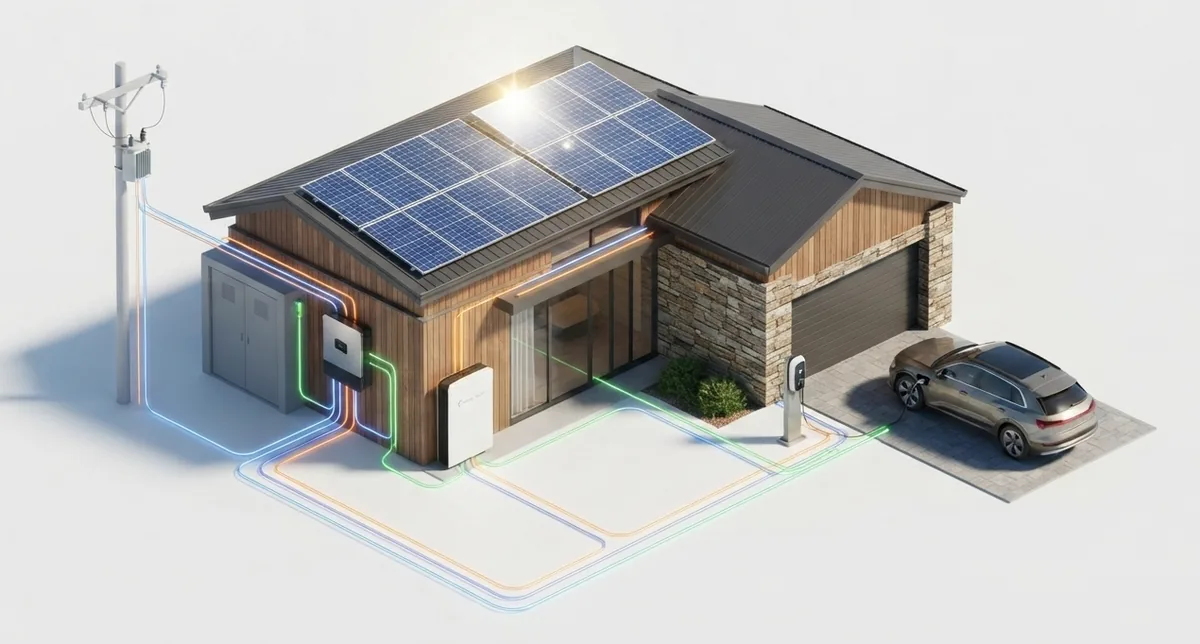
Mostly single storey, which helps. A single-storey roof is safer and quicker to work on and usually gives better access to the full roof plane.
Switchboard age varies across the suburb. Cranebrook's housing spans several decades, so the switchboard question is genuinely open rather than predictable. It is assessed and priced before you sign rather than raised on installation day.
Usable faces, not total roof area. The north and west area that can actually carry panels is normally smaller than the roof appears. In a hot suburb the western face carries an extra consideration: it generates into the afternoon peak, which is valuable, but it also runs hottest.
Three-phase supply appears on some properties here. Since the flexible export allowance applies per phase, that changes the sizing arithmetic once 30 November passes. Confirm your supply type before comparing quotes.
Batteries in Cranebrook
A battery is sized against evening and overnight consumption, not against the size of the array. In this climate the figure that matters most is the summer evening: the house is still shedding heat, the air conditioning is still running, and the array has stopped.
A smaller battery that is actually cycled every day beats a large one that is rarely emptied. Where a battery is being retrofitted, the inverter decides most of the cost: adding storage is treated as an upgrade, which brings the connection under current requirements, so an inverter that is not CSIP-AUS approved turns an addition into a replacement plus an addition.
Siting is a design decision here rather than a default. A cooler, ventilated position extends both performance and service life, and it is worth giving up the most convenient wall to get it.
The federal battery discount is applied by the installer at the point of sale through the small-scale certificate mechanism, and the rate steps down over time. Crown Solar sets out the figure applying to your quote in writing rather than publishing one here.
Approvals: Penrith City Council and the NSW planning rules
Cranebrook falls within Penrith City Council. For most rooftop installations the council is not the approval authority, because most rooftop solar in NSW is exempt development under State Environmental Planning Policy (Transport and Infrastructure) 2021 and requires no development application.
The exemption is conditional, with a capacity limit and a restriction on panels facing the street among the conditions, and a proposal that does not meet every one of them requires development consent instead. Two further checks are worth making rather than assuming in this part of the council area: the flood position for lots toward the Nepean River and its creek lines, which the council maps, and bushfire-prone land mapping toward the bushland edges. Both bear on where the inverter, battery and switchboard can safely be sited, since those are the ground-level, exposed parts of a system. Crown Solar checks the lot before the quote is finalised.
What the installation actually involves
Site assessment. Roof material, pitch and condition, usable faces, shading, and the inverter position chosen for temperature as well as for cable run.
Switchboard and meter box. Condition and capacity for what is being added.
The existing system, if there is one. Make, model and age of the inverter, and whether it is battery-capable.
Design and quote. Layout by roof face, sizing against your summer afternoon and evening consumption rather than an annual average, and which export arrangement applies given the 30 November date.
Connection application to Endeavour Energy. Nothing is installed before approval, and larger systems may need a fuller network assessment.
Commissioning, metering and handover paperwork.
Find out what your roof can carry
The design starts with your roof and your own bill, not with a number over the phone.
Crown Solar does not quote off a template or over the phone. Every design is built on your own site data.
Common questions about solar in Cranebrook
Should I wait until 30 November 2026?
Usually not. Most of the value of a solar system is in the energy you use yourself rather than the energy you export, and in this climate self-consumption is high because the cooling load runs when the sun is up. What you should insist on is knowing which arrangement your quote assumes, in writing.
Will my panels be damaged by the heat?
No. Panels are built for Australian conditions and carry temperature ratings well above what Cranebrook produces. The issue is lost output on hot days, not damage. The same is less true of equipment installed in a badly chosen position, which is why siting is treated as a design decision.
What should I ask every installer who quotes me?
Where the inverter will be mounted and why, whether the array has an air gap for cooling, what export arrangement applies at your address in writing, and whether the switchboard has been inspected and priced or merely assumed.
What Crown Solar installs here
The panel Crown Solar is currently installing is Trina Solar, fitted as the high-wattage Vertex range, and Trina appears on the Cranebrook record as well. JA Solar is also on file locally, on more than one roof. Crown Solar additionally installs Jinko Solar, AE Solar and LONGi panels.
Inverters and storage
Sungrow accounts for most of the recorded inverters on the Cranebrook jobs, with GoodWe also on file.
Crown Solar also installs FoxESS, Fronius and SAJ inverters, and Tesla Powerwall, Sigenergy and AlphaESS batteries. Which one suits depends on whether you want whole-home backup, whether you expect to expand later, and whether you intend to join a virtual power plant. In this climate the operating temperature range and the siting requirements are a real part of that comparison rather than fine print. Those are the current range, available on any job, not a list of what has been fitted locally.
Talk to Crown Solar about your Cranebrook home
Crown Solar is a NSW electrical contractor, licence 378172C, and a New Energy Tech Approved Seller. The office is at 3B/4 Louise Avenue, Ingleburn, and is open Mon–Fri 9am–5pm.
For a quote on a Cranebrook address, call 1800 38 50 38, email info@crownsolar.com.au, or use the contact form.
Get it in writing for your Cranebrook address
Send the address and your last four quarterly bills. You get a system size, the roof faces it sits on, the export arrangement, and the price. All in writing.
Prefer email? info@crownsolar.com.au. One question to start with: what is your place using in a quarter?