Solar and battery installation in Forster
Forster is on Essential Energy and reaches flexible exports on 31 January 2027. On a coastal roof the mounting hardware and the warranty conditions matter as much as the panel on the brochure.
Solar in Forster: a coastal roof is a different specification
Forster accounts for four completed Crown Solar installations. Where a system size is recorded, the two figures on file are 3.5kW and 6.6kW. The smallest on this site. Two records are not a local figure and this page does not present them as one, but the direction is worth noting, because a coastal town with a significant share of part-year and retired households has a genuinely different consumption pattern from a growth-corridor suburb in Sydney.
Forster is in the MidCoast Council area, on the coast at the mouth of Wallis Lake. Two things follow from that, and both matter more than the panel brand on the brochure: the network is Essential Energy, which has its own equipment rules, and the salt air sets the specification for everything that holds the array to the roof.
One other thing should be said plainly rather than left for you to work out. Crown Solar operates from Ingleburn in south-western Sydney. The four Forster jobs are real, but for a Mid North Coast address the practical questions are scheduling and how a service call would be handled, and both are worth settling in writing before you sign rather than discovering later.
Your grid connection: Essential Energy, postcode 2428
Forster is on the Essential Energy network, not Ausgrid and not Endeavour. Essential covers regional New South Wales and runs its own rollout, its own export arrangements and its own approved equipment list, so guidance written for a Sydney postcode does not transfer. Essential approves your connection and sets your export limit; your electricity retailer does neither.
Flexible exports reach 2428 on 31 January 2027
Essential's network-wide rollout of the emergency backstop and flexible exports began on 23 November 2026, but that is the network start date, not Forster's. On Essential's published postcode rollout, postcode 2428 has a date of 31 January 2027. The middle of Essential's three groups.
Essential states that applications submitted and approved before the rollout reaches a postcode follow the existing connection process, and fixed export limits apply. So a Forster system connected now is connected under the existing arrangement, not the flexible one, and a quote describing a flexible export range without noting the January date has described a connection you cannot yet have.
From 23 November 2026 the NSW CER Installer Portal is mandatory across the Essential network for registering, testing and commissioning all new and upgraded solar systems up to 200kW. So the portal obligation and the export change are separate events, falling about two months apart here.
Essential's equipment rule is stricter than CSIP-AUS alone
A CSIP-AUS compliant inverter is necessary but not sufficient on Essential Energy. Essential publishes its own list of supported devices for emergency backstop and flexible exports: equipment that is CSIP-AUS compliant and has been onboarded by Essential Energy to its utility server.
A device can be perfectly compliant, widely available and well reviewed, and still not be eligible on your connection because the manufacturer has not completed onboarding with Essential. Equipment should be checked against Essential's supported list before it is quoted or ordered, not after. Crown Solar does that check as part of the design.
The emergency backstop
The emergency backstop mechanism is a last-resort safety measure for rare conditions known as Minimum System Load events, when more rooftop solar is flowing into the grid than can be used. In practice Essential would signal eligible systems to temporarily reduce exports or pause generation for a short time. It is expected to be used rarely and briefly, and it does not change whether solar is worth installing. It changes what equipment is acceptable.
Coastal exposure: the part of the quote to read twice
This is the section that earns its place on a Forster page, and it is where cheap installations on this coast go wrong.
Salt air attacks the mounting system, not the glass. The panels themselves are glass and framed aluminium and cope well. What suffers near the coast is everything that fixes them down and connects them: rails, clamps, brackets, fixings, roof penetrations and the enclosures of ground-level equipment. Corrosion resistance there is a specification, chosen for the exposure, rather than something that comes as standard. Ask what the rails, clamps and fixings are made of and why those were selected for a coastal site.
Manufacturers' warranties commonly carry distance-from-the-surf conditions. Panel and inverter warranties frequently include terms about installation within a certain distance of breaking surf or in a marine environment, and those terms can reduce or exclude cover. This is not a reason to avoid solar on the coast; it is a reason to get the applicable condition in writing before you order, so that the warranty you think you are buying is the warranty you have. An installer who has worked on this coast will know the question. One who has not will wave it away.
Wind loading is higher and it is a calculation. On an exposed coastal roof the mounting system has to be designed for the site's wind loading, which typically means more mounting points and closer rail spacing than the same array would need inland. That is a structural requirement rather than an optional upgrade, and a design that simply reuses an inland layout has skipped it.
Soiling is different here too. Salt deposit and wind-blown sand build up on panel surfaces, and in some positions they do so faster than rain clears them. Access for inspection and occasional cleaning is worth considering at design stage rather than after.
Inverter siting. An inverter in a sheltered, ventilated position away from direct salt-laden wind will last better than one on an exposed seaward wall. Where it goes is a design decision, and on the coast that decision has a service-life consequence.
What Forster properties mean for system design
Flood and coastal hazard mapping matter for ground-level equipment. MidCoast Council maintains flood risk management work for the Wallis Lake catchment and coastal hazard studies along this stretch of coast, including at One Mile Beach. Where a lot is affected, the siting of the inverter, battery and switchboard becomes a deliberate decision rather than a default, because those are the ground-level, water-sensitive parts of the system. The position for your property is established from the council's mapping before the quote is finalised.
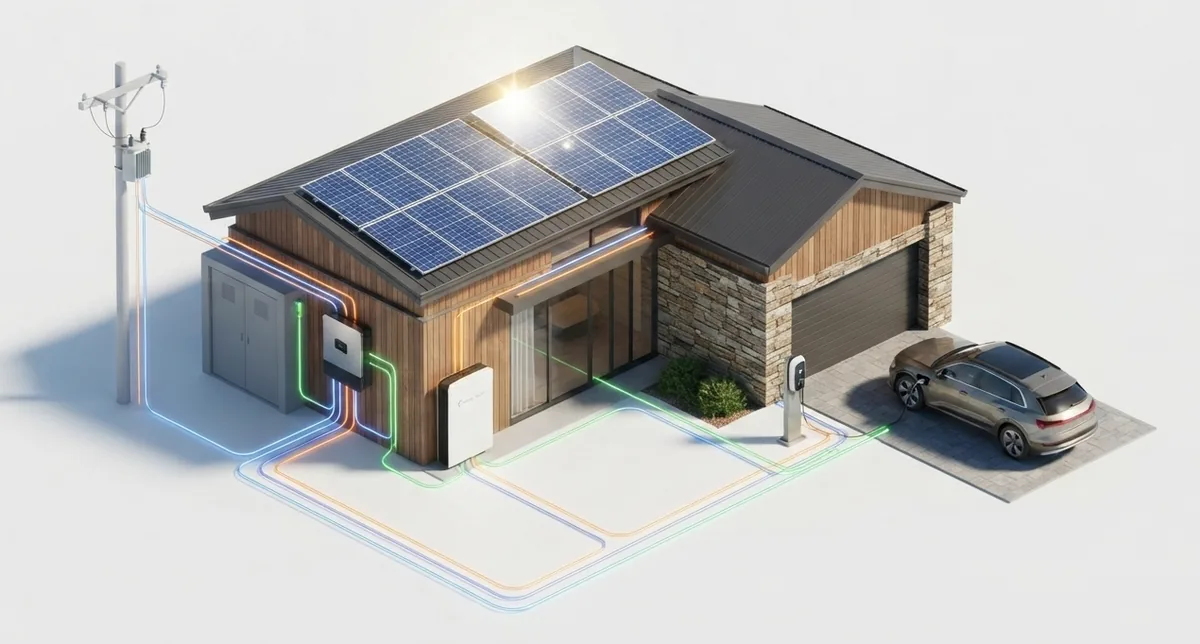
Part-year occupancy changes the sizing question completely. If a house is occupied for part of the year, or let seasonally, its consumption pattern is nothing like a permanently occupied home's. Sizing an array and a battery against an annual average in that situation produces the wrong answer in both directions. The useful exercise is to look at the actual pattern across twelve months of bills, including the quiet months.
Roof material varies with the era of the street. Sheet metal is common in coastal housing of several decades, and where metal roofing is older the fixings and the sheet condition both bear on whether the roof should be addressed before an array goes on it. A roof close to needing work is cheaper to do first than to do under panels later.
Shading is usually modest but not absent. Established coastal gardens and remnant trees can shade a face for hours in winter, when the sun is roughly thirty degrees lower. Shading is assessed for the winter sun path rather than from how the roof looks in summer.
Batteries in Forster
All four Forster jobs involve storage, which makes the sizing logic worth stating properly.
A battery is sized against evening and overnight consumption, not against the size of the array. On a modest array the daytime surplus is smaller, so the sensible battery is usually smaller too, and a smaller battery that is actually cycled every day beats a large one that is rarely emptied.
Outage resilience is a legitimate separate reason to want storage here, and it deserves to be specified rather than assumed. Whole-home backup, a selected essential circuit, or no backup at all are three different specifications at three different prices. Say at the quote stage what you need to keep running, because the answer narrows the equipment list.
Where a battery is being retrofitted, the inverter decides most of the cost. Adding storage is treated as an upgrade, which brings the connection under current requirements, so an inverter that is not on Essential's supported list turns an addition into a replacement plus an addition.
The federal battery discount is applied by the installer at the point of sale through the small-scale certificate mechanism, and the rate steps down over time. Crown Solar sets out the figure applying to your quote in writing rather than publishing one here.
Approvals: MidCoast Council and the NSW planning rules
Forster falls within MidCoast Council. For most rooftop installations the council is not the approval authority, because most rooftop solar in NSW is exempt development under State Environmental Planning Policy (Transport and Infrastructure) 2021 and requires no development application.
The exemption is conditional, with a capacity limit and a restriction on panels facing the street among the conditions, and a proposal that does not meet every one of them requires development consent instead. On this coast two further checks are worth making rather than assuming: the coastal and flood mapping described above, and bushfire-prone land mapping, which applies around the bushland edges of the Forster and Tuncurry area. Crown Solar checks the lot before the quote is finalised.
What the installation actually involves
Equipment check against Essential's supported list. Done before anything is quoted or ordered.
Site assessment. Roof material, age and condition, usable faces, winter shading, exposure to salt-laden wind, and the inverter position chosen with that exposure in mind.
Mounting specification. Hardware selected for corrosion resistance and a layout designed for the site's wind loading, both stated rather than implied.
Warranty conditions. Any distance-from-surf or marine-environment terms identified and put in writing before ordering.
Flood and coastal mapping. Checked against the lot, which decides where ground-level equipment can go.
Design and quote. Sizing against the property's actual occupancy pattern, battery sizing against overnight use and any backup requirement, and which export arrangement applies given the 31 January 2027 date.
Connection application to Essential Energy. Nothing is installed before approval.
Commissioning, metering and handover paperwork, with the service arrangements confirmed in writing.
Find out what your roof can carry
The design starts with your roof and your own bill, not with a number over the phone.
Crown Solar does not quote off a template or over the phone. Every design is built on your own site data.
Common questions about solar in Forster
Should I wait until 31 January 2027?
Usually not, and less so where storage is part of the system, because a battery is about self-consumption rather than export. What you should insist on is knowing which arrangement your quote assumes, in writing, either way.
My installer says the inverter is CSIP-AUS compliant. Is that enough?
Not on Essential Energy. The device also has to appear on Essential's own supported list, which it onboards individually. Ask for confirmation against that list specifically, for the new equipment and for any inverter already on your roof.
Will the salt air ruin the system?
Not if it is specified for the location. Coastal installations last when the mounting hardware, fixings and equipment positions are chosen for the exposure, and they corrode early when inland hardware is used because it was what was on the van. That is the difference worth paying for, and it is a question you can ask directly.
What Crown Solar installs here
The panel Crown Solar is currently installing is Trina Solar, fitted as the high-wattage Vertex range. On the local record AE Solar is the panel on the Forster roofs on file, on more than one of them, from the earlier years of this work. AE Solar is a German-designed panel built for difficult conditions, using hot-spot-free technology that keeps output stable when part of a panel is shaded. Crown Solar also installs JA Solar, Jinko Solar, AE Solar and LONGi panels.
Inverters and storage
AlphaESS accounts for the recorded batteries on the Forster jobs, on all four of them, which in a region where the supported-device list is a real constraint is worth something practical: the installer knows what Essential will accept and what it will not.
Crown Solar installs FoxESS, Sungrow, Fronius, GoodWe and SAJ inverters, and Tesla Powerwall, Sigenergy and AlphaESS batteries. On Essential Energy, whichever combination is proposed has to be checked against the supported list before it is ordered. Those are the current range, available on any job, not a list of what has been fitted locally.
Talk to Crown Solar about your Forster home
Crown Solar is a NSW electrical contractor, licence 378172C, and a New Energy Tech Approved Seller. The office is at 3B/4 Louise Avenue, Ingleburn, and is open Mon–Fri 9am–5pm.
For a quote on a Forster address, call 1800 38 50 38, email info@crownsolar.com.au, or use the contact form.
Get it in writing for your Forster address
Send the address and your last four quarterly bills. You get a system size, the roof faces it sits on, the export arrangement, and the price. All in writing.
Prefer email? info@crownsolar.com.au. One question to start with: what is your place using in a quarter?