Solar and battery installation in Mascot
Mascot is on the Ausgrid network, not Endeavour, so almost everything written about the November 2026 export changes in western Sydney does not describe your connection. It is also the most apartment-heavy suburb on this site.
Solar in Mascot: a different network, and mostly a different kind of building
Mascot carries ten completed Crown Solar installations. Three record a system size, between 13.3kW and 15.5kW, which is nowhere near enough to publish a median and is not presented as one.
Two things make Mascot genuinely different from the south-west and north-west suburbs that make up most of Crown Solar's work, and both change the advice.
The first is the network. Mascot is on Ausgrid, not Endeavour Energy. Every Mascot job on the record carrying a meter identifier shows an Ausgrid network prefix. That matters because almost everything written in the last few months about NSW export limits has been about Endeavour's rollout, and none of those dates are yours.
The second is the building stock. Mascot has been rebuilt over the last fifteen years into one of Sydney's denser apartment precincts. For a large share of residents the question is not which panels go on their roof, because the roof is not theirs to decide about.
Your grid connection: Ausgrid, postcode 2020
Ausgrid approves your connection and sets your export arrangement. Your electricity retailer does neither.
What is actually changing on Ausgrid
From 23 November 2026, Ausgrid launches the first release of Ausgrid Connect for embedded generation applications, which is a new system and a new way of signing in. Other application types continue through the existing process for now. There are planned outages of the current portal over the preceding weekend to allow the transition.
For a homeowner this is mostly your installer's problem rather than yours, but it is worth knowing that applications lodged around that date are passing through a system change, and that an installer who has not noticed may be slower than usual.
On exports, Ausgrid now offers a choice between a flexible export connection, which permits the maximum export, and a fixed export connection, which is constantly lower. Ausgrid does not publish the kilowatt figures for each on its connection page, and this site will not invent them. Ask for the specific limits that apply to your address in writing as part of the quote, because that figure determines what your system is worth.
The NSW-wide requirements, which do apply here
Separately from anything network-specific, new requirements are being phased in from November 2026 for all new and upgrading solar systems in NSW. Ausgrid states them plainly: the system must include a smart solar inverter capable of responding to an emergency backstop, must be registered in the NSW Government's CER Installer Portal, and must be connected to the internet and communicating securely with network systems.
The internet requirement is not a formality. Ausgrid asks that your inverter stays connected so it can communicate with the network and export your excess solar.
Ausgrid also says plainly that you should always use a Solar Accreditation Australia (SAA) accredited installer, and that after installation you should receive a Certificate of Compliance for Electrical Work confirming the system was installed and tested safely. Some systems are inspected after connection, and a system with a safety issue can be disconnected until it is fixed. Keep that certificate; you will want it if you sell.
Apartments: a decision for the owners corporation
If you live in an apartment in Mascot, rooftop solar is not a decision you can make alone. The roof is common property and the project belongs to the owners corporation.
There is, however, NSW funding aimed specifically at this. NSW funding for shared solar on apartment buildings exists under the Solar for Apartment Residents program, and it is limited. Confirm the current terms, caps and closing date on the NSW Government program page before counting on it, because the figures and the window both change. Eligibility is assessed by the program, and your owners corporation or installer makes the application.
A shared system is a different kind of project from a house: the question is how the generation is allocated between common property and individual lots, how it is metered, and what the building's daytime base load actually is. Lifts, lighting, ventilation, car park and pool plant. That base load is often the strongest part of the case, because it runs during the hours the panels produce.
What Mascot properties mean for system design
Flight path and overshadowing. Mascot sits beside the airport and within a precinct of tall buildings. Overshadowing from a neighbouring tower is a far more serious design factor here than tree shade is in a suburban street, and it can change through the day in ways a single site visit does not reveal. It should be modelled rather than eyeballed.
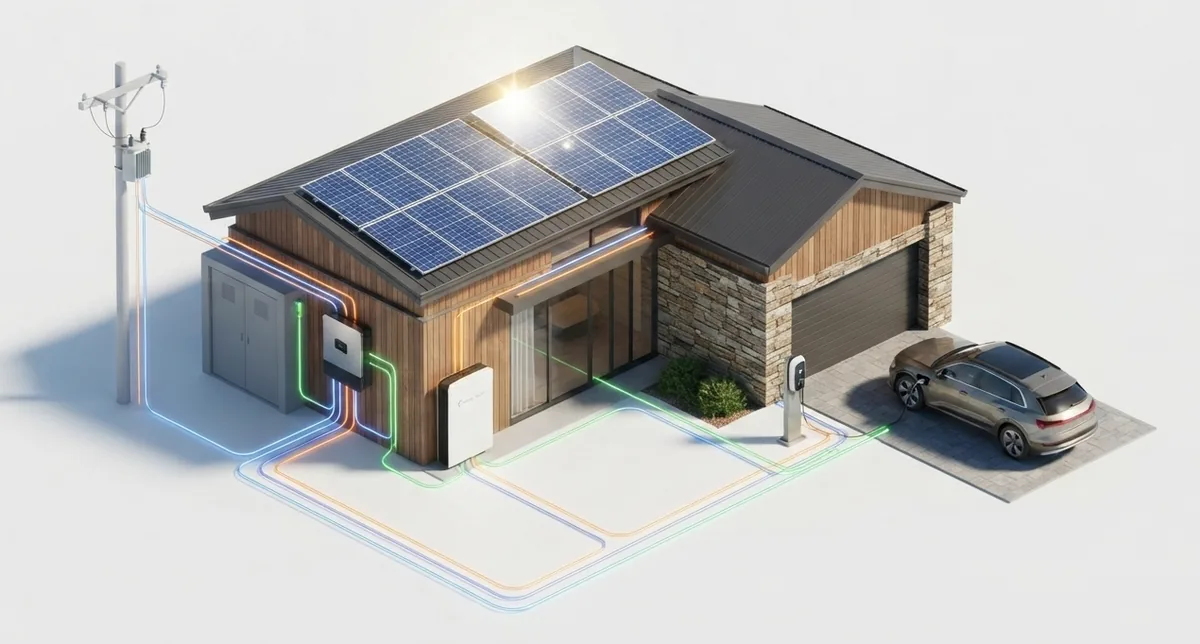
Flat commercial and apartment roofs. Most roofs in this precinct are flat rather than pitched, which means tilt frames, ballast or penetration decisions, wind loading, and a structural view on whether the roof can carry the array. That is an engineering question before it is a solar one.
Three-phase and demand charges. Commercial and strata supplies here are generally three-phase, and the bills often carry demand charges as well as consumption charges. Solar can reduce consumption charges substantially and leave a demand charge largely untouched. Whether storage changes that depends on the tariff and the load shape, and it is a question your interval data answers. The commercial solar page covers how these are scoped.
The panels on the Mascot jobs are not all one brand. Risen appears most, with LONGi also present. The panel Crown Solar is currently installing is Trina, and it also installs JA Solar, Jinko and AE Solar; which suits a particular roof is a site question rather than a catalogue one.
Batteries in Mascot
Most of the Mascot jobs where a type was recorded involve storage. On a commercial or strata site a battery is frequently doing something other than storing surplus: shifting load to manage a demand charge, or providing a measure of resilience. Those are different objectives with different sizing logic, and they are worth stating explicitly before anyone specifies hardware.
For a house, the usual principle holds: size against evening and overnight consumption, not against the array.
The federal battery discount is applied by the installer at the point of sale through the small-scale certificate mechanism, and the rate steps down over time, so Crown Solar states the figure applying to your quote in writing rather than publishing one here.
Approvals: Bayside Council and the NSW planning rules
Mascot is in the Bayside Council area. Most rooftop solar in NSW is exempt development under State Environmental Planning Policy (Transport and Infrastructure) 2021 and requires no development application, provided every condition is met, including a capacity limit and a restriction on panels facing the street.
In this precinct two things push work outside that exemption more often than they would in a suburban street: the capacity limit, which larger commercial and strata arrays exceed, and the building type, since a shared system on an apartment roof is assessed on its own terms. Heritage items and conservation areas in the older pockets are a further check.
What the installation actually involves
Site assessment. Roof type and structure, overshadowing from neighbouring buildings modelled through the day, supply arrangement, metering, and for a strata project the allocation and base load questions.
Design and quote. Layout, equipment selection, and the export arrangement Ausgrid will permit at your address, stated in writing.
Connection application to Ausgrid. Submitted by your installer, through Ausgrid Connect for embedded generation from 23 November 2026.
Installation by a licensed electrician and an SAA accredited installer, with a Certificate of Compliance for Electrical Work afterwards.
Internet connection check, so the inverter can communicate with Ausgrid and export your excess solar.
Find out what your roof can carry
The design starts with your roof and your own bill, not with a number over the phone.
Crown Solar does not quote off a template or over the phone. Every design is built on your own site data.
Common questions about solar in Mascot
Does the 2 November export change apply to me?
No. That is Endeavour Energy's rollout and Mascot is on Ausgrid. Ausgrid runs its own process and its own timetable, with Ausgrid Connect launching for embedded generation on 23 November 2026.
I own an apartment. What can I actually do?
Raise it with your owners corporation, and raise the Solar for Apartment Residents program with it. NSW funding toward a shared system is a materially different proposition from funding one entirely from the sinking fund, so the current terms and closing date are worth confirming on the NSW Government program page before the scheme plans around it.
Will the tower next door ruin my output?
It might, and it might not. It depends on height, distance and orientation, and it changes through the day and the year. It should be modelled properly, and an installer who waves it away has not done the work.
What to check in any Mascot quote
On a strata or commercial roof in this precinct, four questions matter more than the price line.
- Which network, and which export limit in writing. Mascot is Ausgrid. A quote citing Endeavour's November dates was not written for your address, and Ausgrid's own figures are not published, so they have to be asked for.
- Whether the roof structure has been assessed. On a flat apartment or commercial roof, tilt frames, ballast and wind loading are an engineering question before they are a solar one.
- Whether overshadowing was modelled rather than eyeballed. In a precinct of towers it changes through the day and the year, and a single site visit does not show it.
- What the quote claims about demand charges. Solar can cut consumption charges and leave a demand charge largely untouched. Anyone promising otherwise without seeing your interval data is guessing.
Talk to Crown Solar about your Mascot property
Crown Solar is a NSW electrical contractor, licence 378172C, and a New Energy Tech Approved Seller. The office is at 3B/4 Louise Avenue, Ingleburn, open Mon–Fri 9am–5pm.
Call 1800 38 50 38, email info@crownsolar.com.au, or use the contact form. For strata and commercial roofs the direct address is commercial@crownsolar.com.au.
Get it in writing for your Mascot address
Send the address and your last four quarterly bills. You get a system size, the roof faces it sits on, the export arrangement, and the price. All in writing.
Prefer email? info@crownsolar.com.au. One question to start with: what is your place using in a quarter?