Solar and battery installation in Tralee
Tralee is a new estate in New South Wales that sits against the ACT border, so the rules that apply are the NSW ones and advice written for Canberra does not transfer.
Solar in Tralee: a New South Wales estate on the ACT's doorstep
Tralee accounts for four completed Crown Solar installations. Where a system size is recorded, both figures on file are 13.2kW. Two records that land on the same number look like a local standard and are not one. That is a coincidence of a small sample, and this page will not turn it into a Tralee norm.
What does need saying clearly is the jurisdiction. Tralee is a new residential estate in New South Wales, part of the South Jerrabomberra development, sitting immediately against the ACT border a few minutes from Canberra. People living here work in the ACT, shop in the ACT and read Canberra news. None of that changes the rules that apply to your roof.
Tralee is in the Queanbeyan-Palerang Regional Council area, on the Essential Energy network, under NSW planning law. The connection rules, the approval pathway, the equipment list and the export timetable are all the NSW and Essential ones. Advice written for a Canberra suburb, including anything about ACT government programs, ACT network arrangements or ACT connection processes. Does not transfer to a Tralee address, and a quote that leans on it has been prepared for the wrong side of the border.
Your grid connection: Essential Energy, postcode 2620
Tralee is on the Essential Energy network. The Tralee jobs on Crown Solar's record that carry a meter identifier show an Essential network prefix. Essential covers regional New South Wales and runs its own rollout, its own export arrangements and its own approved equipment list. Essential approves your connection and sets your export limit; your electricity retailer does neither.
Flexible exports reach 2620 on 22 February 2027
Essential's network-wide rollout of the emergency backstop and flexible exports began on 23 November 2026, but that is the network start date, not Tralee's. On Essential's published postcode rollout, postcode 2620 has a date of 22 February 2027. The last of Essential's three groups. Queanbeyan, Karabar and Crestwood share the postcode and the date.
Essential states that applications submitted and approved before the rollout reaches a postcode follow the existing connection process, and fixed export limits apply. So a Tralee system connected now is connected under the existing arrangement, not the flexible one, and a quote describing a flexible export range without noting the February date has described a connection you cannot yet have.
From 23 November 2026 the NSW CER Installer Portal is mandatory across the Essential network for registering, testing and commissioning all new and upgraded solar systems up to 200kW. So the portal obligation and the export change are separate events, falling about three months apart here.
Essential's equipment rule is stricter than CSIP-AUS alone
A CSIP-AUS compliant inverter is necessary but not sufficient on Essential Energy. Essential publishes its own list of supported devices for emergency backstop and flexible exports: equipment that is CSIP-AUS compliant and has been onboarded by Essential Energy to its utility server.
A device can be perfectly compliant, widely available and well reviewed, and still not be eligible on your connection because the manufacturer has not completed onboarding with Essential. On a new home this cuts in a particular way: if the builder fitted a system, the inverter on your wall was chosen by the builder's supplier, not by you, and whether it is on Essential's list is a question worth answering before you plan a battery. Equipment should be checked against the supported list before it is quoted or ordered, not after. Crown Solar does that check as part of the design.
The emergency backstop
The emergency backstop mechanism is a last-resort safety measure for rare conditions known as Minimum System Load events, when more rooftop solar is flowing into the grid than can be used. In practice Essential would signal eligible systems to temporarily reduce exports or pause generation for a short time. It is expected to be used rarely and briefly, and it does not change whether solar is worth installing. It changes what equipment is acceptable.
A new house on the Southern Tablelands: what that combination means
Tralee is unusual on this site in pairing new-build construction with a genuinely cold climate. Each is familiar; together they change the design.
Cold, clear days generate well. Panel output is rated at a cell temperature of 25°C and falls as the cell gets hotter, so a cold bright winter day on the Tablelands can be genuinely productive. Better, per hour of sun, than the same day in western Sydney. Frost and the occasional snow dusting on a panel surface work the other way, briefly.
Winter load sets the battery, not summer load. Heating is the dominant seasonal load in this climate, and it runs in the evening and overnight when there is no generation at all. The overnight consumption figure a battery is sized against is markedly higher here in winter than in a Sydney equivalent. Sizing a battery from a summer bill in Tralee produces a battery that is too small for the months that matter. That is the single most useful design point on this page.
Roof pitch matters more at this latitude. The lower winter sun angle rewards a steeper pitch and penalises a shallow one more than it would further north. On a new estate the pitch is whatever the builder built, so it is a constraint to design around rather than a choice, and it is worth knowing which way it cuts on your house.
The builder's system decides what is possible. A system fitted during construction is commonly sized to satisfy the energy requirement for the dwelling rather than to match how the household uses power. Panels can usually be added. Whether a battery can be added depends on the make, model and capacity of the inverter already on the wall and whether it is on Essential's supported list. If it is not, adding storage brings the connection under current requirements and the inverter becomes part of the job.
Switchboards are modern, which removes a cost that appears on most quotes in established Queanbeyan suburbs. It is still checked rather than assumed.
Little mature shading now, and that will change. A new estate has young street trees and few established canopies, so winter shading is unusually light. Where a northern or western neighbouring lot is still vacant or single-storey, it is worth asking what is permissible there, because a two-storey house on the northern boundary changes a low-winter-sun picture considerably.
Estate design guidelines may apply. New lots frequently carry developer design covenants or restrictions registered on the title that limit street-facing equipment independently of the planning rules. They are a private arrangement rather than a council matter, and they are checked against the lot before the layout is fixed.
Batteries in Tralee
Three of the four local jobs involve storage, and in this climate the sizing logic deserves to be precise.
A battery is sized against evening and overnight consumption, not against the size of the array. The figure to look hard at here is the winter one, for the heating reasons above. If you already have panels you are in a good position to answer it, because you have real data on what the system produced and what you exported rather than a projection.
A smaller battery that is cycled every day still beats a large one that is rarely emptied, and oversized storage is an expensive way to feel prepared. The point about winter is not that bigger is always better; it is that the right figure comes from the cold months rather than the warm ones.
Decide what backup means to you before the equipment is chosen. In a cold climate the answer to "what must keep running" often includes heating, and whether the battery and inverter combination can carry that load on backup is a specification question rather than a hope.
The federal battery discount is applied by the installer at the point of sale through the small-scale certificate mechanism, and the rate steps down over time. Crown Solar sets out the figure applying to your quote in writing rather than publishing one here.
Approvals: Queanbeyan-Palerang Regional Council and the NSW planning rules
Tralee falls within Queanbeyan-Palerang Regional Council. For most rooftop installations the council is not the approval authority, because most rooftop solar in NSW is exempt development under State Environmental Planning Policy (Transport and Infrastructure) 2021 and requires no development application.
The exemption is conditional, with a capacity limit and a restriction on panels facing the street among the conditions, and a proposal that does not meet every one of them requires development consent instead. In this part of the council area bushfire-prone land mapping is worth checking rather than assuming, since the estate sits near rural and grassland interfaces, and where a lot is mapped it bears on equipment siting and cable routing. Crown Solar checks the lot before the quote is finalised.
What the installation actually involves
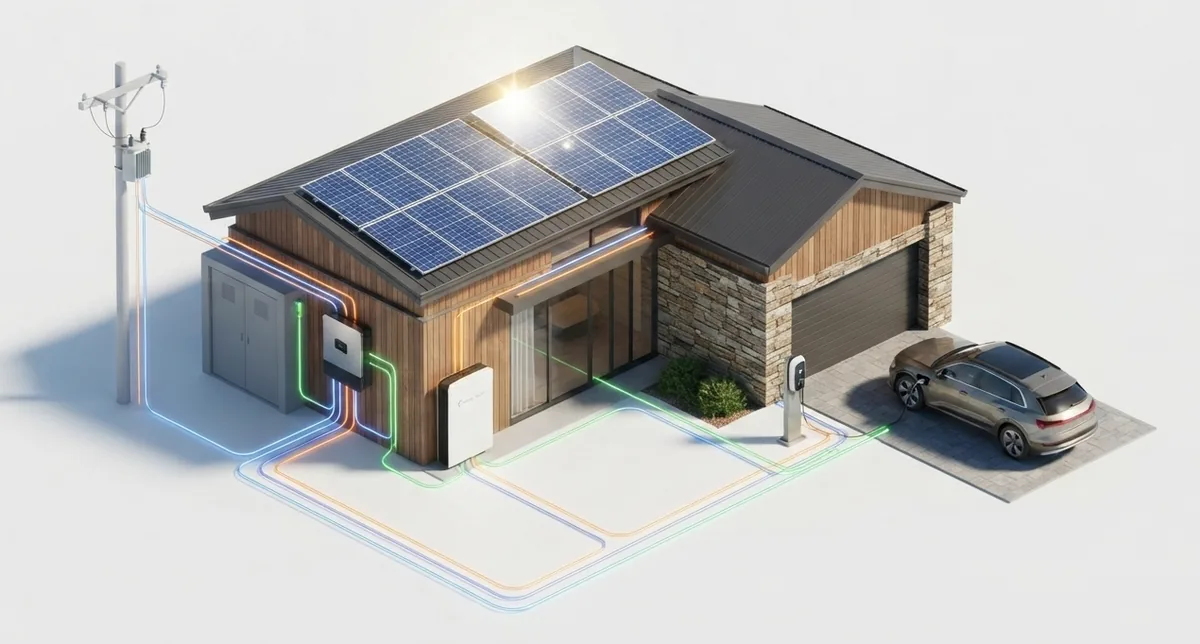
The existing system first, if the builder fitted one. Make, model, age and capacity of the inverter, and whether it is on Essential's supported list.
Equipment check against Essential's supported list. Done before anything is quoted or ordered.
Site assessment. Roof pitch and orientation, current and likely future shading, and the inverter position with its internet coverage.
Estate design guidelines and title conditions. Checked against the lot, not assumed.
Design and quote. Battery sized against your winter overnight consumption, the backup requirement specified, and which export arrangement applies given the February 2027 date.
Connection application to Essential Energy. Nothing is installed before approval.
Commissioning, metering and handover paperwork.
Find out what your roof can carry
The design starts with your roof and your own bill, not with a number over the phone.
Crown Solar does not quote off a template or over the phone. Every design is built on your own site data.
Common questions about solar in Tralee
Should I wait until 22 February 2027?
Usually not, and less so where storage is part of the system, because a battery is about self-consumption rather than export. What you should insist on is knowing which arrangement your quote assumes, in writing, either way.
A Canberra company quoted me. Does that matter?
Only if they have quoted against the wrong rules, which is the thing to check rather than assume. A capable installer on either side of the border can do the work; what matters is that the quote names Essential Energy, the 22 February 2027 date for 2620, the NSW exempt development pathway, and equipment confirmed against Essential's supported list.
My house came with solar. Is it worth adding to?
Often, but the first question is the inverter rather than the panels, and on Essential there are two tests it has to pass: CSIP-AUS approval and presence on Essential's own supported list. Establish that before any battery is priced.
What Crown Solar installs here
The panel Crown Solar is currently installing is Trina Solar, fitted as the high-wattage Vertex range. On the local record Canadian Solar is the panel on the Tralee roofs on file, on more than one of them, from the earlier years of this work. That distinction is worth having if you are comparing a quote today against what a neighbour had fitted: the panel on your quote is the current one, not the one on their roof. Crown Solar also installs JA Solar, Jinko Solar, AE Solar and LONGi panels.
Inverters and storage
FoxESS appears on the recorded Tralee equipment, and AlphaESS on the storage side. In a region where the supported-device list is a real constraint, working repeatedly with the same equipment on the same network is worth something practical: the installer knows what Essential will accept and what it will not.
Crown Solar also installs Sungrow, Fronius, GoodWe and SAJ inverters, and Tesla Powerwall and Sigenergy batteries. On Essential Energy, whichever combination is proposed has to be checked against the supported list before it is ordered. Those are the current range, available on any job, not a list of what has been fitted locally.
Talk to Crown Solar about your Tralee home
Crown Solar is a NSW electrical contractor, licence 378172C, and a New Energy Tech Approved Seller. The office is at 3B/4 Louise Avenue, Ingleburn, and is open Mon–Fri 9am–5pm.
For a quote on a Tralee address, call 1800 38 50 38, email info@crownsolar.com.au, or use the contact form.
Get it in writing for your Tralee address
Send the address and your last four quarterly bills. You get a system size, the roof faces it sits on, the export arrangement, and the price. All in writing.
Prefer email? info@crownsolar.com.au. One question to start with: what is your place using in a quarter?