Solar and battery installation in Marayong
Both recorded Marayong systems are exactly 8.8kW. Identical figures usually mean two households bought the same package, not that they needed the same system.
Solar in Marayong: two systems, the same number, and why that is not reassuring
Marayong accounts for three completed Crown Solar installations. Two carry a recorded system size, and both are exactly 8.8kW.
Two identical figures look like confirmation. They are closer to the opposite. When two different houses end up with precisely the same system size, the most likely explanation is that both bought a standard package, a common inverter size with a panel count to match, rather than that two independent designs happened to arrive at the same answer from different roofs and different bills.
That is not a criticism of either installation. An 8.8kW system on a 6kW-class inverter is a sensible, well-trodden configuration and it suits a great many houses. The point is narrower and more useful: two identical records are weaker evidence about your house than two different ones would be, because they tell you about the product on offer rather than about the range of correct answers in the suburb.
Marayong sits in the Blacktown City Council area on postcode 2148, which it shares with Blacktown.
Why packages cluster, and what to ask instead
A kilowatt figure is the easiest thing in solar to put in an advertisement. It is one number, it sounds like capability, and it lets two quotes be compared at a glance. So the market organises itself around a handful of sizes that match common inverter ratings, and those sizes get offered at the door regardless of what is on the roof behind it.
The figure is indifferent to the two things that actually determine your output. Which roof faces the panels sit on, and how much of the generation your household can use or export.
So the questions worth asking are not about the number.
Which faces, at what orientation? The usable north and west area on a conventional house is routinely about half what the roof looks like from the street. An 8.8kW array on good faces and an 8.8kW array that fills a southern face to reach the figure are different purchases with the same label.
What consumption was the size derived from? Twelve months of bills, ideally with interval data split between daytime and after dark. Many retailers provide it on request or through an online portal, and a smart meter makes it precise rather than estimated. Without it the size came from somewhere other than your house.
Does the inverter leave headroom? Every inverter has a rated capacity and an allowed ratio by which the panel array may exceed it. A package sized tight to that ratio cannot be expanded later without replacing the inverter, which matters if an electric vehicle or a battery is in your plans.
And what happens to the surplus? Until February 2027 a fixed export limit applies here, so generation you can neither use nor export is generation you paid for once. That is the arithmetic that decides whether the last few panels earn anything at all.
Your grid connection: Endeavour Energy, postcode 2148
Marayong is in the Endeavour Energy distribution area. The Marayong jobs on Crown Solar's record that carry a meter identifier show an Endeavour network prefix. Endeavour approves the connection and sets the export limit. Your electricity retailer does neither.
Where 2148 sits in Endeavour's rollout
Endeavour stages flexible exports by postcode, not by council.
-
Stage 1, commenced 2 November 2026 Postcodes in and around the Campbelltown, Camden, Picton and Liverpool regions.
-
Stage 2, commences 30 November 2026 A further set of postcodes across Endeavour's area.
-
Phase 3, February 2027 Endeavour has published the month and not a day within it. Its rollout map gives the date for a specific address. Postcode 2148 is in this stage
What you may export, by connection type
Endeavour Energy, kilowatts per phase.
Flexible exports reach 2148 in the February 2027 phase
Endeavour has published two rollout stages by postcode. The first commenced on 2 November 2026, covering postcodes in and around the Campbelltown, Camden, Picton and Liverpool regions. The second commences on 30 November 2026 and adds a long list of Blue Mountains, Penrith, Hawkesbury and Illawarra postcodes. 2148 appears in neither, which places Marayong in the February 2027 phase of Endeavour's availability plan. Endeavour has published the month, not a date within it, so this page gives the month and nothing more precise. Treat any quote that names a specific February day for 2148 as unsourced.
Blacktown council spans postcodes on more than one date, since the staging is by postcode rather than by council. Glenwood on 2768, Bungarribee on 2767 and Quakers Hill on 2763 are also in the February phase, while 2765 to the north moves on 30 November.
When it applies, a flexible export connection allows up to 10kW per phase to be exported most of the time, reduced only when local grid conditions require it. The opt-out is Endeavour's Fixed Exports plan with a maximum export of 1.5kW. Until then, an application submitted and approved under the existing process carries a fixed export limit, and that position should appear on your quote in writing.
What your system has to meet
Endeavour requires an address in its network area, an active internet connection by Wi-Fi or cable, net export metering configured for the solar inverter, and a CSIP-AUS approved inverter listed on the Clean Energy Council website.
The emergency backstop mechanism allows the network to curtail exports when the grid cannot absorb what is being sent into it. Endeavour describes it as a last resort, expected to be used rarely and for short periods.
What Marayong properties mean for system design
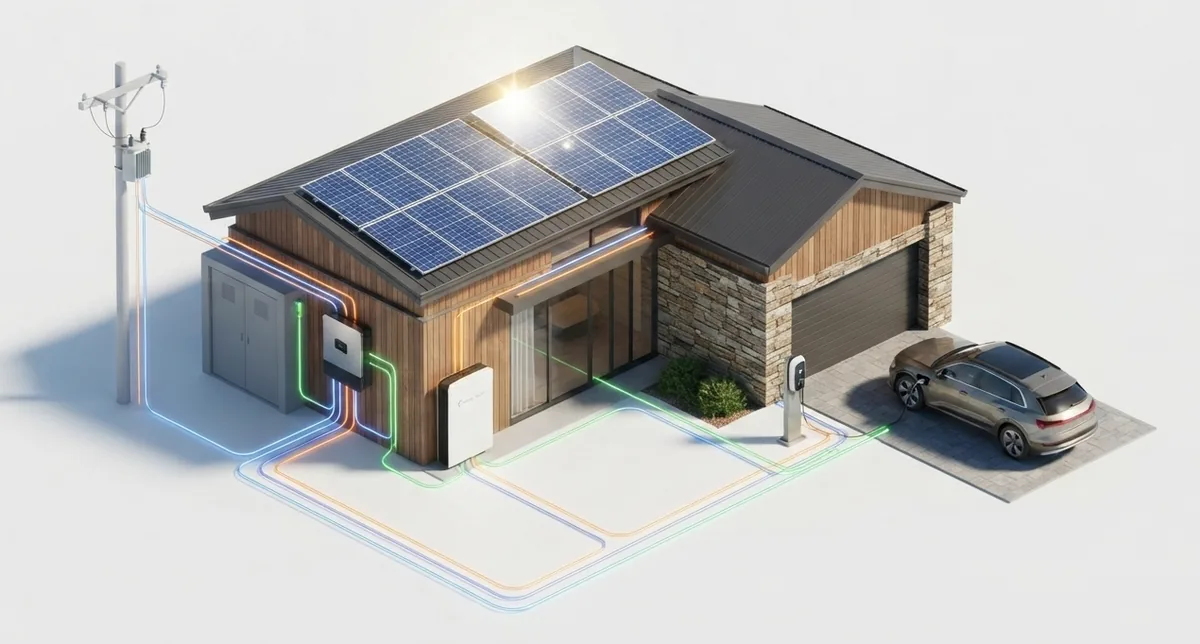
Established housing, so switchboard age is the recurring cost. A board of this era frequently needs replacement or upgrade before a battery, in capacity, protective devices and physical space. It should be assessed and priced before you sign rather than raised on installation day. On a packaged quote this is the line most often left out, and it is the line most often added on the day.
Asbestos in a pre-1990 house is a constraint to plan for. Bonded asbestos cement sheeting was used in Australian housing until the late 1980s, including eaves linings and meter box backing boards. Where it is present it changes how cable is run and who may do that work. The eaves and meter box are inspected during the assessment rather than discovered with a drill.
Mixed roof ages and materials. Tile and sheet metal both appear, sometimes on one house where an addition has been built. Older tiles are brittle, so the mounting method and the number of tiles lifted matter, and a competent installer expects to replace a few.
Roof condition decides the sequence. Where a roof is close to needing replacement or significant repair, doing that first and the solar second is cheaper than paying to remove and refit an array later. The roof is assessed at quote stage.
Heat, because this is western Sydney. Panels are rated at a cell temperature of 25°C and output falls as the cell rises above it, and inverters reduce their own output when they overheat. So the inverter position is a design decision: out of direct afternoon sun, with airflow around it, and not boxed into an unventilated cupboard. A packaged quote rarely says where the inverter is going; ask.
Decades of garden growth. A tree that casts nothing on the roof in January can cover a significant part of an array at nine in the morning in June, because the sun is roughly thirty degrees lower. Shading is assessed for the winter sun path rather than from how the roof looks on the day of the visit.
Batteries in Marayong
No battery is recorded on any of the local jobs, so the Marayong record is solar rather than storage. That is the position most households here would be adding to.
A battery is sized against evening and overnight consumption, not against the size of the array. If you already have panels, your own export figures are the best available evidence of how much generation is currently going to waste.
A smaller battery that is actually cycled every day beats a large one that is rarely emptied.
The inverter decides most of the cost of a retrofit. Adding storage is treated as an upgrade, which brings the connection under current requirements, so an inverter that is not CSIP-AUS approved has to be replaced as part of the job. If you are buying solar now and expect a battery later, this is the moment to specify an inverter that is CSIP-AUS approved and battery-capable with capacity headroom. A packaged quote will often not do that unless asked.
The federal battery discount is applied by the installer at the point of sale through the small-scale certificate mechanism, and the rate steps down over time. Crown Solar sets out the figure applying to your quote in writing rather than publishing one here.
Approvals: Blacktown City Council and the NSW planning rules
Marayong falls within Blacktown City Council. For most rooftop installations the council is not the approval authority, because most rooftop solar in NSW is exempt development under State Environmental Planning Policy (Transport and Infrastructure) 2021 and requires no development application.
The exemption is conditional, with a capacity limit and a restriction on panels facing the street among the conditions, and a proposal that does not meet every one of them requires development consent instead. For lots near the creek lines through this part of Blacktown the flood position is worth establishing from council mapping, because it bears on where ground-level equipment can safely be sited. Crown Solar checks the lot before the quote is finalised.
What the installation actually involves
Twelve months of consumption. Bills and, where available, interval data split between daytime and after dark, because that is where the size should come from.
Site assessment. Every usable roof face with orientation and pitch, roof condition, winter shading, and the inverter position chosen for temperature as well as cable run.
Switchboard, meter box and eaves. Condition, capacity, and whether pre-1990 sheeting is present.
Inverter selection with headroom stated, if a battery or an expansion is likely later.
Design and quote. Layout by roof face, sizing against your own consumption with the reasoning shown, and the export arrangement that applies given the February 2027 phase.
Connection application to Endeavour Energy. Nothing is installed before approval.
Commissioning, metering and handover paperwork.
Find out what your roof can carry
The design starts with your roof and your own bill, not with a number over the phone.
Crown Solar does not quote off a template or over the phone. Every design is built on your own site data.
Common questions about solar in Marayong
Should I wait for February 2027?
Generally not. Most of the value of a solar system is in the energy you use yourself rather than the energy you export, and in this climate self-consumption is high because the cooling load runs when the sun is up. What you should insist on is the arrangement being stated in writing on the quote.
Is 8.8kW a bad size?
Not at all. It is a sound, common configuration. The question is whether it was chosen for your roof and your bills or offered because it is the size on the price list. Both can end up at 8.8kW; only one of them can tell you why.
What should I ask every installer who quotes me?
Which roof faces carry the panels and at what orientation, what consumption figure the size was derived from, whether the inverter leaves headroom for a battery or more panels, where the inverter will be mounted and why, and whether the switchboard was inspected or assumed.
What Crown Solar installs here
The panel Crown Solar is currently installing is Trina Solar, fitted as the high-wattage Vertex range. On the local record Jinko Solar and Canadian Solar panels appear on the Marayong roofs on file, from the earlier years of this work. That distinction is worth having if you are comparing a quote today against what a neighbour had fitted: the panel on your quote is the current one, not the one on their roof. Crown Solar also installs JA Solar, AE Solar and LONGi panels.
Inverters and storage
GoodWe and Fronius both appear on the recorded Marayong inverters.
Crown Solar also installs FoxESS, Sungrow and SAJ inverters, and Tesla Powerwall, Sigenergy and AlphaESS batteries. Which one suits depends on whether you want whole-home backup, whether you expect to expand later, and whether you intend to join a virtual power plant. If expansion is likely, the inverter choice is the decision that keeps that door open. Those are the current range, available on any job, not a list of what has been fitted locally.
Talk to Crown Solar about your Marayong home
Crown Solar is a NSW electrical contractor, licence 378172C, and a New Energy Tech Approved Seller. The office is at 3B/4 Louise Avenue, Ingleburn, and is open Mon–Fri 9am–5pm.
For a quote on a Marayong address, call 1800 38 50 38, email info@crownsolar.com.au, or use the contact form.
Get it in writing for your Marayong address
Send the address and your last four quarterly bills. You get a system size, the roof faces it sits on, the export arrangement, and the price. All in writing.
Prefer email? info@crownsolar.com.au. One question to start with: what is your place using in a quarter?