Solar and battery installation in Moorebank
Flexible exports already apply in Moorebank. The suburb sits between the Georges River and a major freight precinct, and the flood position for your lot decides where the inverter and battery go.
Solar in Moorebank: a floodplain between a river and a freight terminal
Moorebank accounts for three completed Crown Solar installations. Where a system size is recorded, the two figures on file are 10.1kW and 14.1kW, and both recorded systems are solar only, with no battery. Two records are not a local figure and this page does not present them as one.
Moorebank sits in the Liverpool City Council area on a bend of the Georges River, with Anzac Creek on its other flank, and alongside the Moorebank intermodal freight precinct. A state significant development that has been through years of planning and modification. So the suburb is housing, water and heavy freight in close company, and the first of those three shapes every system design here.
Flood is the spine of this page. Planning material for residential land on Newbridge Road records Liverpool City Council minutes describing properties along that road as among the worst flood ways in New South Wales, and identifies the land as high-risk floodplain under the NSW 2022 Independent Flood Inquiry. The Department of Planning has told the council to consider development appropriate to the flood risk of each site in the Moorebank East precinct and within the evacuation capacity identified for it. That is not uniform across the suburb. It is a lot-by-lot question, but it is the question.
Flood and where the equipment goes
This matters for a practical reason that is easy to miss.
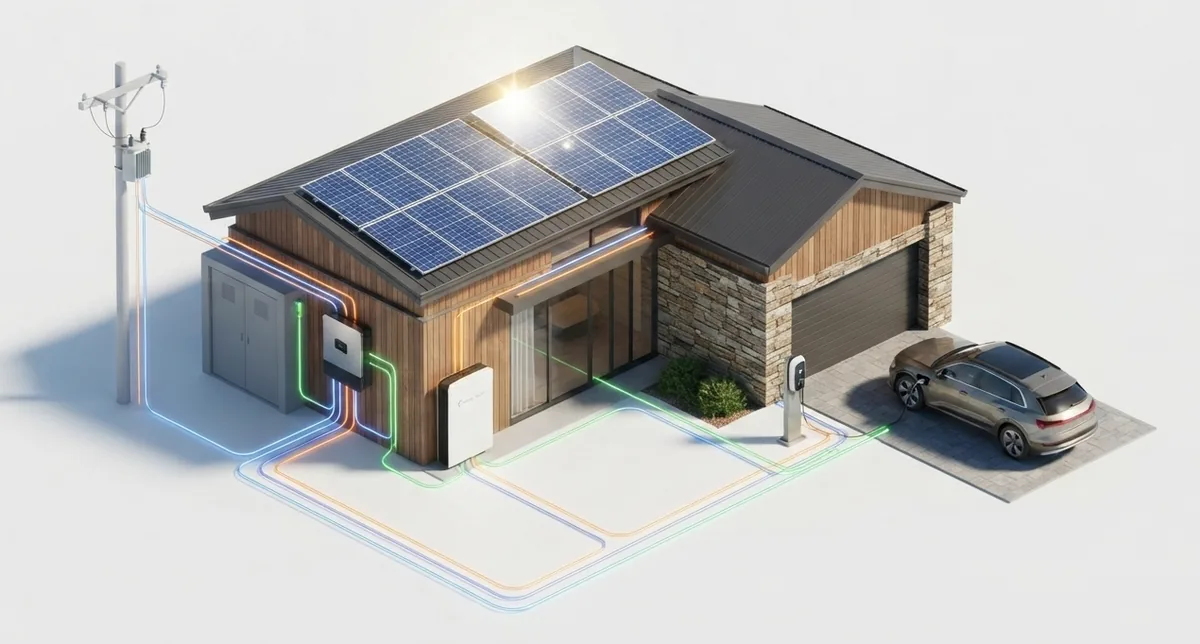
Panels are not the exposed part of a solar system. They are on the roof. The parts a flood reaches are the ones at or near ground level: the inverter, the battery, the switchboard and the isolators. They are also the expensive ones to replace and the ones that have to be made safe before anyone can re-energise the house.
So the flood position for your lot is established before siting, not after. Council mapping gives it. On a lot that is affected, mounting height becomes a deliberate design decision, with consequences for cable runs, service access and sometimes the manufacturer's installation requirements. Where a height is required, it belongs on the quote.
It applies to a battery retrofit just as much as to a new installation, and arguably more, because a battery is a larger, heavier, harder-to-relocate object than an inverter. If you are considering storage on a flood-affected Moorebank lot, settle the siting question before you choose the product, because the installation requirements narrow the field.
And it is separate from the export question. The flood position does not change with the rollout date and will not improve by waiting.
Your grid connection: Endeavour Energy, postcode 2170
Moorebank is in the Endeavour Energy distribution area. Endeavour approves the connection and sets the export limit. Your electricity retailer does neither.
Where 2170 sits in Endeavour's rollout
Endeavour stages flexible exports by postcode, not by council.
-
Stage 1, commenced 2 November 2026 Postcodes in and around the Campbelltown, Camden, Picton and Liverpool regions. Postcode 2170 is in this stage
-
Stage 2, commences 30 November 2026 A further set of postcodes across Endeavour's area.
-
Phase 3, February 2027 Endeavour has published the month and not a day within it. Its rollout map gives the date for a specific address.
What you may export, by connection type
Endeavour Energy, kilowatts per phase.
Flexible exports already apply in 2170
Postcode 2170 is named in the first stage of Endeavour's rollout, which commenced on 2 November 2026 and covers postcodes in and around the Campbelltown, Camden, Picton and Liverpool regions. For Moorebank this is the current arrangement, not a future one. Prestons, Casula and Lurnea share the postcode and the date.
A flexible export connection allows up to 10kW per phase to be exported most of the time, reduced only when local grid conditions require it. The opt-out is Endeavour's Fixed Exports plan with a maximum export of 1.5kW, carrying the same connection requirements. On the systems recorded locally, 1.5kW is a severe restriction rather than a simplification.
Liverpool council is split across dates, since Endeavour stages by postcode rather than by council: 2170 and 2173 moved on 2 November, while 2171 did not move until 30 November. Advice written for "Liverpool" cannot get this right for your address.
What your system has to meet
Endeavour requires an address in its network area, an active internet connection by Wi-Fi or cable, net export metering configured for the solar inverter, and a CSIP-AUS approved inverter listed on the Clean Energy Council website.
The emergency backstop mechanism allows the network to curtail exports when the grid cannot absorb what is being sent into it. Endeavour describes it as a last resort, expected to be used rarely and for short periods.
What Moorebank properties mean for system design
Established housing, so switchboard age is the recurring cost. A board of this era frequently needs replacement or upgrade before a battery, in capacity, protective devices and physical space. It should be assessed and priced before you sign rather than raised on installation day, and on a flood-affected lot its height and position come into the same conversation.
Asbestos in a pre-1990 house is a constraint to plan for. Bonded asbestos cement sheeting was used in Australian housing until the late 1980s, including eaves linings and meter box backing boards. Where it is present it changes how cable is run and who may do that work. It does not prevent an installation; it means the eaves and meter box are inspected during the assessment rather than discovered with a drill.
Riverside blocks can carry significant canopy. The vegetation along the Georges River corridor is mature, and a tree that casts nothing on the roof in January can cover a significant part of an array at nine in the morning in June, because the sun is roughly thirty degrees lower. Shading is assessed for the winter sun path rather than from how the roof looks on the day of the visit.
Dust and soiling near the freight precinct. Where a property sits close to heavy vehicle movements and unsealed working areas, panels soil faster than they would in a quiet street. That is a maintenance reality rather than a fault, and access for occasional cleaning is worth considering at design stage.
Roof condition decides the sequence. Where a roof is close to needing replacement or significant repair, doing that first and the solar second is cheaper than paying to remove and refit an array later. The roof is assessed at quote stage.
Three-phase supply appears on some properties. Since the flexible export allowance applies per phase, that changes the sizing arithmetic. Confirm your supply type before comparing quotes.
Storage on a flood-affected lot
A battery is sized against evening and overnight consumption, not against the size of the array. The useful figure is what the household actually uses after dark, which your bills and meter data answer better than any estimate.
A smaller battery that is actually cycled every day beats a large one that is rarely emptied.
Where flooding is a factor, outage resilience deserves a clear-eyed look rather than an easy sales line. A battery can keep lights and a fridge running through a short outage, and that is worth something. It is not flood protection, and in an evacuation the relevant plan is the council's and the SES's, not an inverter's. This site makes no claim about how a system behaves in any particular local event. What a battery does and does not cover should be written down on the quote.
Where a battery is being retrofitted, the inverter decides most of the cost. Adding storage is treated as an upgrade, which brings the connection under current requirements, so an inverter that is not CSIP-AUS approved turns an addition into a replacement plus an addition.
The federal battery discount is applied by the installer at the point of sale through the small-scale certificate mechanism, and the rate steps down over time. Crown Solar sets out the figure applying to your quote in writing rather than publishing one here.
Approvals: Liverpool City Council and the NSW planning rules
Moorebank falls within Liverpool City Council. For most rooftop installations the council is not the approval authority, because most rooftop solar in NSW is exempt development under State Environmental Planning Policy (Transport and Infrastructure) 2021 and requires no development application.
The exemption is conditional, with a capacity limit and a restriction on panels facing the street among the conditions, and a proposal that does not meet every one of them requires development consent instead. In Moorebank the flood mapping is the check that matters most, because it governs where ground-level equipment can be placed and at what height. Crown Solar checks the lot before the quote is finalised.
What the installation actually involves
Flood position for the lot. From council mapping, because it decides where the inverter, battery and switchboard can go and at what height.
Site assessment. Roof material, pitch, age and condition, usable faces, winter shading from the river corridor, and the inverter position with its internet coverage.
Switchboard, meter box and eaves. Condition, capacity, height, and whether pre-1990 sheeting is present.
The existing system, if there is one. Make, model and age of the inverter, and whether it is battery-capable.
Design and quote. Layout by roof face, equipment positions and heights stated, and the export arrangement, which here is the flexible one already in force.
Connection application to Endeavour Energy. Nothing is installed before approval.
Commissioning, metering and handover paperwork.
Find out what your roof can carry
Postcode 2170 is in Endeavour's first stage. A connection applied for now gets the flexible export limit, not the fixed one.
Crown Solar does not quote off a template or over the phone. Every design is built on your own site data.
Common questions about solar in Moorebank
Is there any reason to wait?
Not on the export question, because 2170 is already in the first stage. The arrangement available to you now is the flexible one, which is the more generous of the two.
Is my lot flood affected?
That is a council mapping question answered for your specific property, not for the suburb, and in Moorebank it varies considerably street to street. Get the answer before you choose a battery, because it can change which installation positions are available and therefore which products are practical.
What should I ask every installer who quotes me?
Whether the flood position for your lot has been checked and what it means for equipment siting and mounting height, whether the switchboard has been inspected and priced or merely assumed, and what export arrangement applies at your address in writing.
What Crown Solar installs here
The panel Crown Solar is currently installing is Trina Solar, fitted as the high-wattage Vertex range. On the local record Jinko Solar and AE Solar panels appear on the Moorebank roofs on file, from the earlier years of this work. That distinction is worth having if you are comparing a quote today against what a neighbour had fitted: the panel on your quote is the current one, not the one on their roof. Crown Solar also installs JA Solar, AE Solar and LONGi panels.
Inverters and storage
GoodWe appears on the recorded Moorebank inverters. No battery is recorded on either of the local systems, so the Moorebank record is solar rather than storage.
Crown Solar also installs FoxESS, Sungrow, Fronius and SAJ inverters, and Tesla Powerwall, Sigenergy and AlphaESS batteries. On a flood-affected lot the installation requirements narrow that field before preference does, so the siting question is settled first. Those are the current range, available on any job, not a list of what has been fitted locally.
Talk to Crown Solar about your Moorebank home
Crown Solar is a NSW electrical contractor, licence 378172C, and a New Energy Tech Approved Seller. The office is at 3B/4 Louise Avenue, Ingleburn, and is open Mon–Fri 9am–5pm.
For a quote on a Moorebank address, call 1800 38 50 38, email info@crownsolar.com.au, or use the contact form. For a warehouse or factory roof in the freight precinct, commercial@crownsolar.com.au reaches the commercial team.
Get it in writing for your Moorebank address
Send the address and your last four quarterly bills. You get a system size, the roof faces it sits on, the export arrangement, and the price. All in writing.
Prefer email? info@crownsolar.com.au. One question to start with: what is your place using in a quarter?