Solar and battery installation in Box Hill
Box Hill is a new suburb on new land, which changes the solar question. Most roofs here are a decade old at most, and the local record is dominated by batteries added to systems that came with the house.
Solar in Box Hill: a new suburb, and a different starting point
Box Hill accounts for five completed Crown Solar installations, and four of the five involve a battery. That is not a coincidence of a small sample. It is what the work looks like in a suburb where almost every house is new enough to have been built with panels already on it.
Box Hill was rezoned as a precinct of the North West Growth Centre, with the amending instrument published in the Government Gazette on 5 April 2013. The precinct covers about 974 hectares and the precinct plan provided land for roughly 9,600 homes and more than 29,700 residents, together with a new town centre and village centres. In practical terms that means the oldest houses here are about a decade old and many are considerably newer.
So the question in Box Hill is rarely "should I get solar". It is more often "what do I do with what the builder put on, and can it carry a battery". Those are different questions with different answers, and a page written for an established suburb answers neither.
Where a system size is recorded on the Box Hill jobs, the two figures on file are 7.7kW and 13.2kW. Two records do not make a local norm and this page will not present them as one.
Your grid connection: Endeavour Energy, postcode 2765
Box Hill is in the Endeavour Energy distribution area. Endeavour approves the connection and sets the export limit. Your electricity retailer does neither, and neither does your builder.
Where 2765 sits in Endeavour's rollout
Endeavour stages flexible exports by postcode, not by council.
-
Stage 1, commenced 2 November 2026 Postcodes in and around the Campbelltown, Camden, Picton and Liverpool regions.
-
Stage 2, commences 30 November 2026 A further set of postcodes across Endeavour's area. Postcode 2765 is in this stage
-
Phase 3, February 2027 Endeavour has published the month and not a day within it. Its rollout map gives the date for a specific address.
What you may export, by connection type
Endeavour Energy, kilowatts per phase.
The second stage, not the first: 30 November 2026
Endeavour's rollout of flexible exports is staged by postcode, not by council, and that distinction does real work in The Hills. The first stage commenced on 2 November 2026 and covered postcodes in and around the Campbelltown, Camden, Picton and Liverpool regions. Postcode 2765 is in the second stage, commencing 30 November 2026.
A flexible export connection allows up to 10kW per phase to be exported most of the time, reduced only when local grid conditions require it. The opt-out is Endeavour's Fixed Exports plan with a maximum export of 1.5kW, which carries the same connection requirements. On a new home with a decent roof area, 1.5kW is a severe constraint rather than a simplification.
Note that 2765 also covers neighbouring suburbs in the same release area, so a Melonba address sits on the same date as a Box Hill one. Two suburbs in different stages of build-out, on one export timetable.
What your system has to meet
Endeavour requires an address in its network area, an active internet connection by Wi-Fi or cable, net export metering configured for the solar inverter, and a CSIP-AUS approved inverter listed on the Clean Energy Council website.
The internet requirement is worth a second look on a new estate. The inverter is usually mounted in the garage or on an external wall, and that is frequently the weakest Wi-Fi position in a new double-storey house with insulated internal walls. It is a connection requirement, not a nice-to-have, so the signal at the inverter position is checked during the assessment rather than discovered at commissioning.
The emergency backstop mechanism allows the network to curtail exports when the grid cannot absorb what is being sent into it. Endeavour describes it as a last resort, expected to be used rarely and for short periods. It changes what equipment is acceptable, not whether solar is worth having.
The builder's system: what to check before you add to it
This is the most useful section on the page for a Box Hill address, because it is the situation most local households are actually in.
The inverter decides what is possible. A system fitted during construction is commonly sized to satisfy the BASIX energy requirement for the dwelling rather than to match how the household ended up using power. The panels can usually be added to. Whether a battery can be added depends on the make, model and capacity of the inverter already on the wall, and whether it is CSIP-AUS approved. If it is not, adding storage brings the connection under current requirements and the inverter becomes part of the job.
Know what you have before you compare quotes. The inverter make and model are on the unit itself and on your installation paperwork. Two quotes that look thousands of dollars apart often differ on exactly one point: whether the existing inverter has been priced for replacement. Ask each installer which assumption they have made.
Roof warranty and penetrations. A roof a few years old still carries warranty conditions, and the mounting method matters more here than on a thirty-year-old roof. The number and position of penetrations, the flashing detail on a tile roof, and any builder or manufacturer conditions are checked before the layout is fixed.
Where the original installer left room. Builder-fitted arrays are often placed for cost rather than for yield, which can mean the best roof face is still empty. That is good news for an expansion: there may be a better face available than the one already in use.
What Box Hill properties mean for system design
Little mature shading now, and that will change. A new estate has young street trees and few established canopies, so winter shading is unusually light. It will not stay that way. Where a northern or western neighbouring lot is still vacant or single-storey, worth asking what is permissible there, because a two-storey house on the northern boundary changes a low-winter-sun picture considerably.
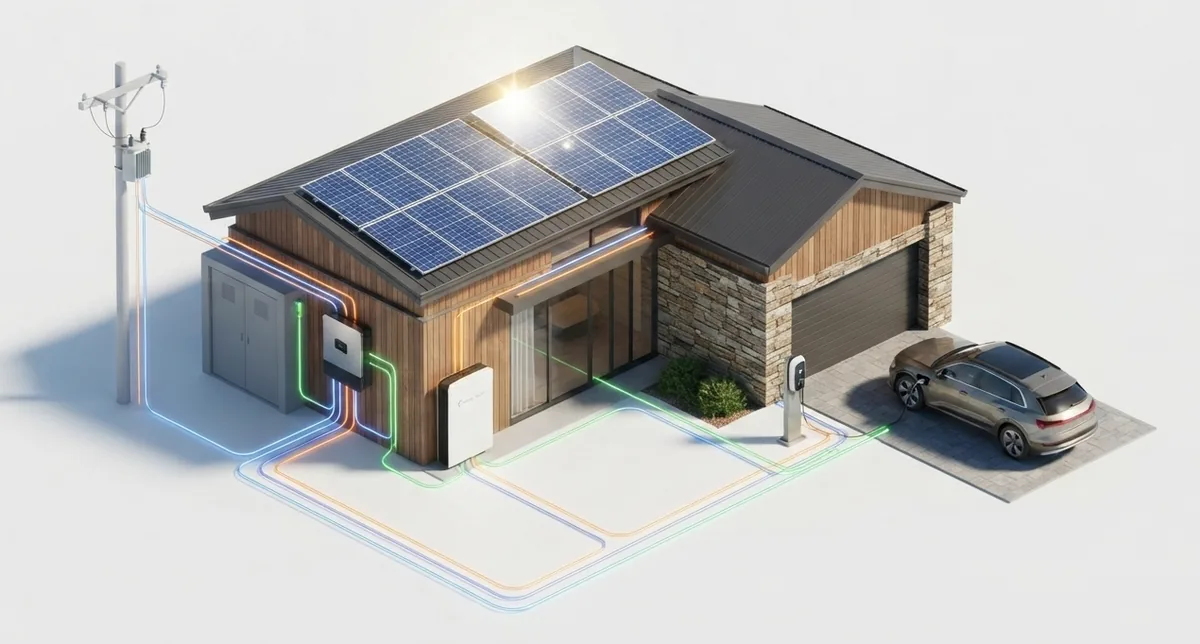
Small lots, close setbacks, two storeys. Growth-area lots are compact and houses are frequently double-storey and close together. That affects access, scaffolding and where an inverter and battery can be sited within the required clearances. The side of a house one metre from the fence is not a free wall.
Roof faces, not roof area. A contemporary roof is often a set of hips and valleys rather than two large planes, so the usable area is smaller than the roof looks and the array is split across more faces. That changes inverter and string selection, and it is a design decision rather than an arithmetic one.
Switchboards are modern, which removes one common cost. Unlike an established suburb, Box Hill switchboards are generally recent and compliant, so the switchboard-upgrade line that appears on many quotes in older areas usually does not apply here. It is still checked rather than assumed.
Three-phase is more common than it used to be. Many newer homes in the growth areas are connected on three phases. Since the flexible export allowance applies per phase, this matters for sizing. Confirm your supply type before comparing quotes.
Batteries in Box Hill
Given the local record is mostly storage, the sizing question is worth being precise about.
A battery is sized against evening and overnight consumption, not against the size of the array. If you already have panels, you are in a better position than most to answer that, because you have real data on what the system produced and what you exported rather than a projection.
A smaller battery that is actually cycled every day is a better outcome than a large one that is rarely emptied. On a new estate with a young household and a daytime-empty house, the overnight figure is often the one that decides it.
The federal battery discount is applied by the installer at the point of sale through the small-scale certificate mechanism, and the rate steps down over time. Crown Solar sets out the figure applying to your quote in writing rather than publishing one here.
Approvals: The Hills Shire Council and the NSW planning rules
Box Hill falls within The Hills Shire Council. For most rooftop installations the council is not the approval authority, because most rooftop solar in NSW is exempt development under State Environmental Planning Policy (Transport and Infrastructure) 2021 and requires no development application.
The exemption is conditional, with a capacity limit and a restriction on panels facing the street among the conditions, and a proposal that does not meet every one of them requires development consent instead. In a growth-area estate there is a second layer worth checking: design guidelines attached to the land. Many releases carry developer design covenants or an estate design review process, registered on the title or imposed as a condition of the land contract, which can restrict street-facing equipment independently of the planning rules. Those are a private arrangement rather than a council matter, and they are checked against the lot before the layout is finalised.
What the installation actually involves
The existing system first. Make, model, age and capacity of the inverter, whether it is CSIP-AUS approved, and whether it is battery-capable.
Site assessment. Roof type, pitch and condition, usable faces, current and likely future shading, meter box and switchboard, inverter position and the internet signal at that position.
Estate design guidelines and title conditions. Checked against the lot, not assumed.
Design and quote. Layout by roof face, battery sizing against your overnight consumption, and which export arrangement applies given the 30 November date.
Connection application to Endeavour Energy. Nothing is installed before approval.
Commissioning, metering and handover paperwork.
Find out what your roof can carry
The design starts with your roof and your own bill, not with a number over the phone.
Crown Solar does not quote off a template or over the phone. Every design is built on your own site data.
Common questions about solar in Box Hill
Should I wait until 30 November 2026?
Usually not. An application submitted and approved before the rollout reaches your postcode follows the existing connection process, and a fixed export limit applies to it. Whether that matters depends on how much you expect to export rather than use. You should be told which arrangement your quote assumes, in writing, either way.
Can I just add panels without touching the inverter?
Sometimes, up to the inverter's capacity and within the oversizing rules that apply to it. Past that point more panels do nothing, because the inverter becomes the limit. That ceiling is specific to the unit on your wall, which is why the model is the first thing checked.
My neighbour's quote was much cheaper. Why?
On a Box Hill street the usual answer is that one quote includes replacing the builder's inverter and the other does not. It can also be the roof: a simple two-face layout and a six-face layout are different jobs on identically priced equipment.
What Crown Solar installs here
The panel Crown Solar is currently installing is Trina Solar, fitted as the high-wattage Vertex range. On the local record Jinko Solar and AE Solar appear on Box Hill roofs from the earlier years of this work. That distinction is worth having if you are comparing a quote today against what a neighbour had fitted: the panel on your quote is the current one, not the one on their roof. Crown Solar also installs JA Solar, AE Solar and LONGi panels.
Inverters and storage
GoodWe accounts for most of the recorded inverters on the Box Hill jobs, with FoxESS also on file. Both appear on the storage side of the record as well.
Crown Solar also installs Sungrow, Fronius and SAJ inverters, and Tesla Powerwall, Sigenergy and AlphaESS batteries. Which one suits depends on whether you want whole-home backup, whether you expect to expand later, and whether you intend to join a virtual power plant. Those are three genuinely different conversations rather than three names for the same product, and on a retrofit the existing inverter narrows the field before any of them are discussed. Those are the current range, available on any job, not a list of what has been fitted locally.
Talk to Crown Solar about your Box Hill home
Crown Solar is a NSW electrical contractor, licence 378172C, and a New Energy Tech Approved Seller. The office is at 3B/4 Louise Avenue, Ingleburn, and is open Mon–Fri 9am–5pm.
For a quote on a Box Hill address, call 1800 38 50 38, email info@crownsolar.com.au, or use the contact form.
Get it in writing for your Box Hill address
Send the address and your last four quarterly bills. You get a system size, the roof faces it sits on, the export arrangement, and the price. All in writing.
Prefer email? info@crownsolar.com.au. One question to start with: what is your place using in a quarter?