Solar and battery installation in Denham Court
Denham Court is larger lots, sheds and three councils. Postcode 2565 has had Endeavour flexible exports since 2 November 2026, and on an acreage property the export headroom is the whole argument.
Solar in Denham Court: larger lots, and three councils
Denham Court accounts for eight completed Crown Solar installations. It is also the most administratively awkward suburb on this site, and that is worth knowing before anything else.
Denham Court sits across three local government areas. Most of it is in Campbelltown City Council, but the suburb also crosses into Liverpool and Camden, and some streets are in Liverpool rather than Campbelltown. For a homeowner this rarely changes whether solar needs approval, because most rooftop solar in NSW does not. It does change who you are dealing with if a proposal falls outside the exemption, and it means a confident statement about "your council" based on the suburb name alone is a guess. Crown Solar checks the lot.
The land itself is the other defining feature. Denham Court retains a good deal of large-lot and semi-rural property, including the heritage-listed Denham Court homestead, and newer release housing has been added at the edges rather than replacing the lot pattern wholesale. The result is a suburb where one quote may be for a compact new home and the next for an acreage property with a shed, a pump and a sub-board.
Where a system size is recorded, the Denham Court figures run from 7.9kW to 17.6kW across four jobs. Some of the older records here carry 330W panels, which is a reminder that part of the local solar stock dates back several years and is now a candidate for storage rather than a new array.
Your grid connection: Endeavour Energy, postcode 2565
Denham Court is in the Endeavour Energy distribution area. The distributor, not your retailer, approves the connection and sets how much you may export.
Where 2565 sits in Endeavour's rollout
Endeavour stages flexible exports by postcode, not by council.
-
Stage 1, commenced 2 November 2026 Postcodes in and around the Campbelltown, Camden, Picton and Liverpool regions. Postcode 2565 is in this stage
-
Stage 2, commences 30 November 2026 A further set of postcodes across Endeavour's area.
-
Phase 3, February 2027 Endeavour has published the month and not a day within it. Its rollout map gives the date for a specific address.
What you may export, by connection type
Endeavour Energy, kilowatts per phase.
Flexible exports already apply in 2565
Postcode 2565 is named in the first stage of Endeavour's rollout, which commenced on 2 November 2026 and covers postcodes in and around the Campbelltown, Camden, Picton and Liverpool regions. Denham Court is not waiting for this change; it has already happened.
A flexible export connection allows up to 10kW per phase to be exported most of the time, with the limit reduced only when local grid conditions require it. On a three-phase Denham Court property that headroom is substantial, and it is the single strongest argument for sizing an array here against the roof and the load rather than against an old fixed export cap.
The opt-out is Endeavour's Fixed Exports plan, which allows a maximum export of 1.5kW. It carries the same equipment and connection requirements as the flexible plan, so choosing it does not simplify the installation. On a large Denham Court array it would waste a great deal of generation.
What your system has to meet
Endeavour's requirements are an address in the Endeavour network area, an active internet connection by Wi-Fi or cable, net export metering configured for the solar inverter, and a CSIP-AUS approved inverter listed on the Clean Energy Council website.
The internet requirement deserves a specific word here. On a larger lot the switchboard and the likely inverter position can be a long way from the house and the router, and a connection that works at the back door does not necessarily work at the meter box. If the connection drops, the ability to export can be reduced until it is restored. Checking signal strength at the actual inverter location is part of a proper site assessment on an acreage property, not an afterthought.
The NSW CER Installer Portal and the emergency backstop
The NSW CER Installer Portal is becoming mandatory for all new and upgraded consumer energy resource systems, so that they are emergency backstop enabled and able to communicate with network utility servers. It is being introduced by postcode on the same staged basis as the export change, and 2565 is in the first stage.
The emergency backstop mechanism allows the network to curtail exports when more solar is being exported than the grid can absorb. Endeavour describes it as a last resort used rarely and briefly.
What Denham Court properties mean for system design
Four things recur on the larger Denham Court jobs.
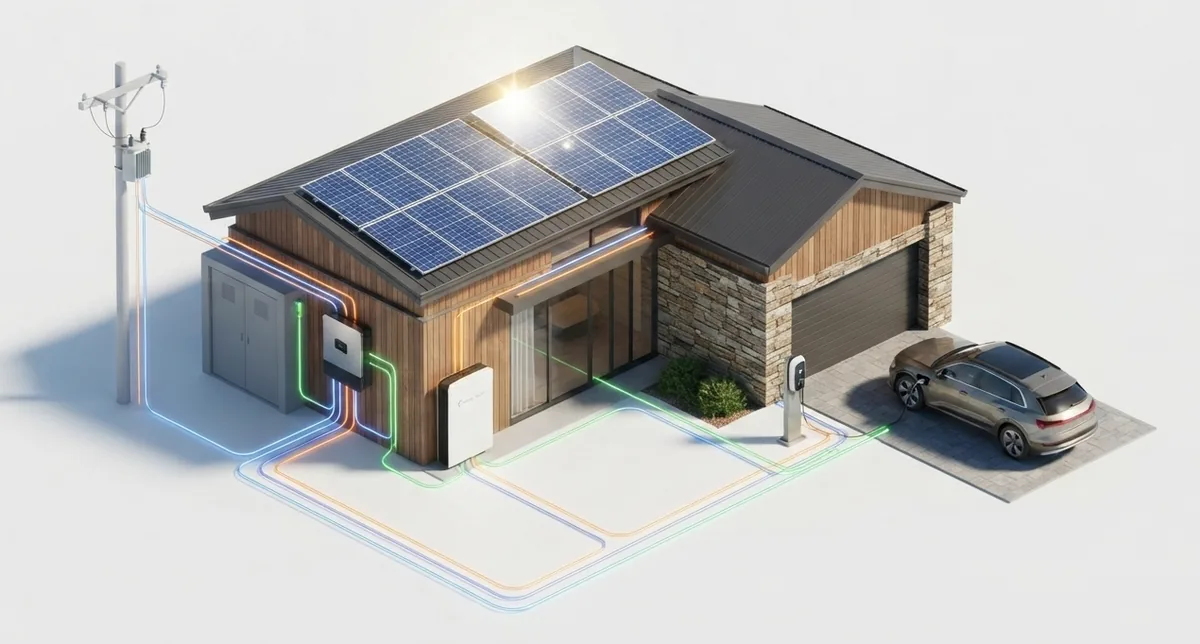
Three-phase supply. Where a property is on three phases the flexible export allowance applies per phase, which changes the sizing arithmetic compared with a single-phase home. It also changes which inverters are suitable. Confirm the supply type before comparing quotes.
Outbuildings and sub-boards. Sheds, granny flats and workshop supplies are common on this lot pattern. They affect where the inverter goes, how the cabling runs, and occasionally whether a sub-board needs work. They also often explain a consumption profile that looks odd on paper.
Motor and pump loads. Where a property has a bore, a pressure pump or workshop equipment, the battery conversation has to cover what the inverter can actually start, not only how many kilowatt hours it stores. Quotes written for suburban houses routinely miss this, and it is worth asking the question explicitly.
Genuine roof area. On the larger properties the limit on system size is usually the connection rules and the budget rather than the available space, and the shed is sometimes a better mounting surface than the house. That is a pleasant problem, but it makes it easy to be sold more panels than the load justifies. The twelve-month bill is the check.
Batteries in Denham Court
Storage features in the Denham Court record, and on a large property with a substantial evening load and good daytime export the case tends to be stronger than average. It is still a case to be made from your own data rather than assumed.
Where part of the local solar stock is now several years old, the first question for a retrofit is the inverter: whether it is CSIP-AUS approved and whether it is battery-capable. Where it is neither, the upgrade can mean replacing it, and that cost belongs in the quote from the start rather than emerging partway through the job.
The federal battery discount is delivered through the small-scale certificate mechanism and applied by the installer at the point of sale. The rate steps down over time, so Crown Solar states the figure applying to your quote in writing rather than publishing one here that would age.
Approvals: your council, and the NSW planning rules
Most rooftop solar in NSW is exempt development under State Environmental Planning Policy (Transport and Infrastructure) 2021, which means no development application is required where every condition is met, including a capacity limit and a restriction on street-facing panels.
On Denham Court's larger and more rural lots, three further checks matter more than they do in an estate. Bushfire-prone land mapping, which can affect the planning position as well as the installation detail. Heritage, given the listed homestead and its surrounds. And whether a ground-mounted array rather than a roof-mounted one is being contemplated, which is a different planning question entirely.
Because the suburb spans Campbelltown, Liverpool and Camden, the lot is checked against the right council's mapping rather than the one the postcode suggests. Crown Solar does that before finalising a quote.
What the installation actually involves
Site assessment. Roof orientation and shading, single or three-phase supply, switchboard and sub-board condition, inverter location, and internet coverage at that location.
Design and quote. Array layout by roof face or by shed, inverter and battery selection, and the export arrangement that applies to your connection.
Connection application to Endeavour Energy. Work does not start before the Permission To Connect letter is in hand.
Installation. A standard residential job is a day; a larger three-phase array with storage and sub-board work is longer.
Commissioning, metering and handover paperwork.
Find out what your roof can carry
Postcode 2565 is in Endeavour's first stage. A connection applied for now gets the flexible export limit, not the fixed one.
Crown Solar does not quote off a template or over the phone. Every design is built on your own site data.
Common questions about solar in Denham Court
Which council am I actually in?
Most of Denham Court is Campbelltown, but the suburb crosses into Liverpool and Camden and some streets are in Liverpool. It is checked against the lot rather than assumed, and for most rooftop installations it makes no practical difference because no development application is required.
The inverter will be a long way from my router. Is that a problem?
It can be. Flexible exports require an active internet connection at the inverter. It is a solvable problem, but it needs to be identified at the assessment rather than discovered at commissioning.
My property is on three-phase. Does that change anything?
Yes, and in your favour under flexible exports, because the allowance applies per phase. It also affects which inverters are suitable, so confirm the supply type before comparing quotes.
What a Denham Court system actually looks like
Four of the eight Denham Court jobs carry a recorded system size, running from 7.9kW to 17.6kW.
No median is published here, and four records is the reason. A median drawn from four numbers carries more authority than the underlying data can support, and on a lot pattern this varied it would be particularly misleading: the 7.9kW job and the 17.6kW job are not the same customer making different choices, they are different kinds of property. A quote at the bottom of that range suits a compact home; a quote at the top belongs to an acreage property with outbuildings and, often, three-phase supply.
Panels
The panel Crown Solar is currently installing is Trina Solar, fitted as the high-wattage Vertex range. Crown Solar also installs JA Solar, Jinko Solar, AE Solar and LONGi panels. On the large, often unshaded roofs here the property that matters is how a module holds output at high cell temperature, because on an exposed west-facing plane it is heat rather than available light that limits summer output.
On the local record, Jinko Solar appears on more existing Denham Court roofs than any other brand, from the earlier years of this work, and some of those records carry 330W modules. A useful marker of how much the panels on offer have changed. Crown Solar also installs JA Solar, Jinko and AE Solar panels, and which suits your roof is a site-assessment question rather than a brand preference.
Inverters and storage
The Denham Court record spreads across several inverter brands rather than concentrating on one, which is what you would expect where jobs span a number of years. Crown Solar installs Sungrow, Fronius, GoodWe and SAJ inverters, and Tesla Powerwall, Sigenergy, FoxESS and AlphaESS batteries. Those are the current range, available on any job, not a list of what has been fitted locally.
On a rural-fringe property the inverter choice is doing more work than it would on a suburban roof, because it has to handle the starting currents of pumps and workshop equipment as well as the export arrangement. None of these should be confirmed as suiting your property before someone has assessed it.
Talk to Crown Solar about your Denham Court property
Crown Solar is a NSW electrical contractor, licence 378172C, and a New Energy Tech Approved Seller. The office is at 3B/4 Louise Avenue, Ingleburn, a short run from Denham Court, and is open Mon–Fri 9am–5pm.
For a quote on a Denham Court address, call 1800 38 50 38, email info@crownsolar.com.au, or use the contact form.
Get it in writing for your Denham Court address
Send the address and your last four quarterly bills. You get a system size, the roof faces it sits on, the export arrangement, and the price. All in writing.
Prefer email? info@crownsolar.com.au. One question to start with: what is your place using in a quarter?