Solar and battery installation in Horsley Park
Horsley Park is acreage and industrial land in the same postcode, so the job varies more here than in any suburban street. Endeavour reaches 2175 in February 2027.
Solar in Horsley Park: acreage and industrial on one postcode
Horsley Park accounts for three completed Crown Solar installations. Where a system size is recorded, there is one figure on file, at 13.3kW. One record is not a local figure and this page will not present it as one.
What makes the suburb unusual is its land. Horsley Park is predominantly rural small-lot land. Roughly RU4 Primary Production Small Lots across most of its area, with holdings commonly running from a couple of acres to ten or more, and it also carries a substantial band of general industrial land, with parts of the suburb sitting against the Western Sydney Parklands. It is in the Fairfield City Council area.
So "a Horsley Park job" can mean a house on five acres with a machinery shed and a pressure pump, or a factory roof, or a hobby farm with stables. Those are genuinely different pieces of work, and a page that assumed any one of them would mislead two thirds of the people reading it.
Something worth raising before the engineering
Parts of the Fairfield rural lands, Horsley Park included, sit within an area the council has been examining for possible future rezoning. Nothing on this page depends on how that turns out, and this is not a prediction.
But a solar system is a twenty-year asset bolted to a roof, and if you expect to sell, subdivide or redevelop within a few years, that changes the arithmetic rather than the engineering. Two things are worth thinking through in that case: whether the payback period you are being shown actually fits your plans for the property, and what happens to the system if the building it is on comes down. Neither question has a standard answer. Both are better asked before you sign than afterwards, and an installer who will not raise them is not looking after you.
If you have no such plans, none of this applies and the rest of the page is the ordinary case.
Your grid connection: Endeavour Energy, postcode 2175
Horsley Park is in the Endeavour Energy distribution area. Endeavour approves the connection and sets the export limit. Your electricity retailer does neither.
Where 2175 sits in Endeavour's rollout
Endeavour stages flexible exports by postcode, not by council.
-
Stage 1, commenced 2 November 2026 Postcodes in and around the Campbelltown, Camden, Picton and Liverpool regions.
-
Stage 2, commences 30 November 2026 A further set of postcodes across Endeavour's area.
-
Phase 3, February 2027 Endeavour has published the month and not a day within it. Its rollout map gives the date for a specific address. Postcode 2175 is in this stage
What you may export, by connection type
Endeavour Energy, kilowatts per phase.
Flexible exports reach 2175 in the February 2027 phase
Endeavour has published two rollout stages by postcode. The first commenced on 2 November 2026, covering postcodes in and around the Campbelltown, Camden, Picton and Liverpool regions. The second commences on 30 November 2026 and adds a long list of Blue Mountains, Penrith, Hawkesbury and Illawarra postcodes. 2175 appears in neither, which places Horsley Park in the February 2027 phase of Endeavour's availability plan. Endeavour has published the month, not a date within it, so this page gives the month and nothing more precise.
When it applies, a flexible export connection allows up to 10kW per phase to be exported most of the time, reduced only when local grid conditions require it. The opt-out is Endeavour's Fixed Exports plan with a maximum export of 1.5kW.
The per-phase basis is the sentence that matters on acreage. Three-phase supply is common on rural and industrial properties here, and on three phases the arithmetic changes substantially. Establish your supply type before anyone quotes you an export figure.
What your system has to meet
Endeavour requires an address in its network area, an active internet connection by Wi-Fi or cable, net export metering configured for the solar inverter, and a CSIP-AUS approved inverter listed on the Clean Energy Council website.
The internet requirement is a genuine piece of work on rural land, not a formality. Where the switchboard sits in a shed or on a pole a long way from the house, the inverter position may have no usable Wi-Fi at all, and a cable run or a dedicated link becomes part of the job rather than an afterthought. The signal at the inverter position is checked during the assessment.
Larger systems carry a further consideration. Streamlined approval pathways apply up to certain inverter capacity thresholds, and above those a proposal can require a more detailed network assessment, which takes longer and may carry a cost. On a shed-scale or industrial system that timeline belongs in the plan from the beginning.
The emergency backstop mechanism allows the network to curtail exports when the grid cannot absorb what is being sent into it. Endeavour describes it as a last resort, expected to be used rarely and for short periods.
Designing for acreage
The best roof is often not the house. A machinery shed, barn, stable block or large garage frequently offers a bigger, simpler, better-oriented and completely unshaded plane. The trade-off is distance.
Voltage drop over distance is the rural cost nobody quotes for. Running a long way from an outbuilding back to the main switchboard means heavier cable, and heavier cable costs money. Undersize it and you lose output permanently and quietly. The cable run is calculated rather than estimated, and on a large block it can decide which roof gets used even when the shed has the better aspect.
Pumps change the load profile completely. Many properties here are on tank or bore water, which means a pressure pump, and some run irrigation as well. A pump is a large intermittent load with a high starting current, and when it runs decides whether that energy comes from the array, the battery or the grid. It affects both battery sizing and inverter selection, and whether a battery can start it on backup is a specification question rather than a hope.
Backup is a deliberate choice on a rural block. Whole-property backup, a selected essential circuit, or none are three different specifications at three different prices. During an outage, water usually matters more than lighting, so say at the quote stage what must keep running.
Dust, stock and access. Panels on a shed near unsealed driveways or stockyards soil faster than panels on a suburban roof, which is a maintenance reality rather than a fault. Access for cleaning and inspection is worth considering at design stage.
Heat, because this is western Sydney. Panels are rated at a cell temperature of 25°C and output falls as the cell rises above it, and inverters reduce their own output when they overheat. On a shed with a tin roof and no shade anywhere, the inverter position and airflow around it are design decisions rather than conveniences.
If the roof is industrial
On the industrial land the questions change again, and three matter most.
Structure before layout. A commercial roof is assessed for its structural capacity to carry the array and for the wind loading at the site, not simply for its area. Purlin spacing, sheet thickness and condition, and existing fixings decide what can be mounted and how.
Daytime load, not storage. Where a business runs plant, compressors, lighting or refrigeration through the working day, generation is consumed as it is made and a battery adds cost without adding much use. Storage earns its place on a commercial site for a specific reason. A night shift, a demand charge on the tariff, or a process that must not stop, rather than as a general upgrade.
Who owns the building. On a leased unit the roof belongs to the landlord and the power bill to the tenant, so the work needs the owner's authority and an agreement about who funds it and who keeps the benefit. It is the most common reason a commercial solar project stalls.
Storage on a Horsley Park property
A battery is sized against evening and overnight consumption, not against the size of the array. On acreage that figure is higher and lumpier than in a suburb, because pumps, sheds, workshops and sometimes a second dwelling sit on the same meter.
A smaller battery that is cycled every day still beats a large one that is rarely emptied, and oversizing storage is an expensive way to feel prepared.
Where a battery is being retrofitted, the inverter decides most of the cost. Adding storage is treated as an upgrade, which brings the connection under current requirements, so an inverter that is not CSIP-AUS approved turns an addition into a replacement plus an addition.
The federal battery discount is applied by the installer at the point of sale through the small-scale certificate mechanism, and the rate steps down over time. Crown Solar sets out the figure applying to your quote in writing rather than publishing one here.
Approvals: Fairfield City Council and the NSW planning rules
Horsley Park falls within Fairfield City Council. For most rooftop installations the council is not the approval authority, because most rooftop solar in NSW is exempt development under State Environmental Planning Policy (Transport and Infrastructure) 2021 and requires no development application.
On rural-zoned land the exemption needs checking rather than assuming. It carries a capacity limit among its conditions, so a large shed-mounted or ground-mounted array can fall outside it and require development consent. A commercial-scale array on industrial land can do the same. Bushfire-prone land mapping is also worth establishing, particularly toward the parklands and bushland edges, because it bears on where ground-level equipment can be sited and how cable is routed. The zone and the mapping that apply are confirmed against the lot rather than inferred from the suburb, since Horsley Park carries more than one.
What the installation actually involves
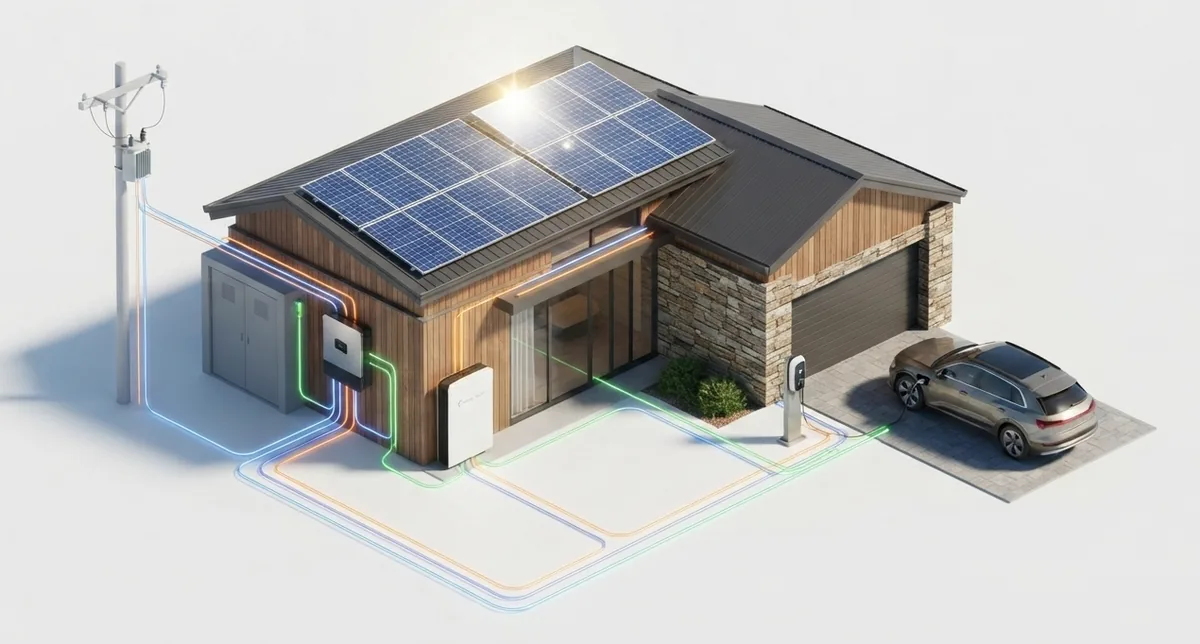
What the property actually is. Zone, land use and whether the work is residential, rural or commercial, because the approval pathway follows from it.
Site assessment across the whole property. Every candidate roof, not only the house: orientation, pitch, structure and shading on each.
Supply and switchboard. Single or three phase, switchboard location and condition, and the distance from each candidate roof to it.
Load profile including pumps. What runs, when, and what must keep running in an outage.
Cable run calculation. Voltage drop for each option, which can decide which roof is used.
Bushfire mapping and cable routing. Checked against the lot.
Design and quote. Layout by roof, battery sizing against overnight and pump load, and the per-phase export position for February 2027.
Connection application to Endeavour Energy. Nothing is installed before approval, and larger systems may need a fuller network assessment.
Commissioning, metering and handover paperwork.
Find out what your roof can carry
The design starts with your roof and your own bill, not with a number over the phone.
Crown Solar does not quote off a template or over the phone. Every design is built on your own site data.
Common questions about solar in Horsley Park
Should I wait for February 2027?
Generally not. Most of the value is in the energy you use yourself rather than the energy you export, and on a property with pumps and sheds self-consumption is high. What you should insist on is the arrangement being stated in writing on the quote.
Should the array go on the ground?
It is possible on acreage and occasionally the best answer, but it is a different approval pathway and a different cost structure: footings, framing, cable and stock protection. On rural-zoned land it can require development consent, and on bushfire-mapped land the siting is constrained. Worth pricing against a shed-mounted option rather than assumed either way.
You only have one recorded system size. Does that matter?
For your quote, no. The design comes from your buildings, your supply arrangement and your load. It matters only for what this page can honestly claim about local figures, which is why none are published.
What Crown Solar installs here
The panel Crown Solar is currently installing is Trina Solar, fitted as the high-wattage Vertex range. On the local record Jinko Solar and LONGi panels appear on the Horsley Park roofs on file, from the earlier years of this work. That distinction is worth having if you are comparing a quote today against what a neighbour had fitted: the panel on your quote is the current one, not the one on their roof. Crown Solar also installs JA Solar, AE Solar and LONGi panels.
Inverters and storage
GoodWe and FoxESS both appear on the recorded Horsley Park inverters, with FoxESS on the storage side of the record.
Crown Solar also installs Sungrow, Fronius and SAJ inverters, and Tesla Powerwall, Sigenergy and AlphaESS batteries. On a three-phase rural or industrial property the choice is narrowed first by capacity and by what you need backed up, and only then by preference. Those are the current range, available on any job, not a list of what has been fitted locally.
Talk to Crown Solar about your Horsley Park property
Crown Solar is a NSW electrical contractor, licence 378172C, and a New Energy Tech Approved Seller. The office is at 3B/4 Louise Avenue, Ingleburn, and is open Mon–Fri 9am–5pm.
For a house or acreage at a Horsley Park address, call 1800 38 50 38, email info@crownsolar.com.au, or use the contact form. For a shed, factory or warehouse roof, commercial@crownsolar.com.au reaches the commercial team.
Get it in writing for your Horsley Park address
Send the address and your last four quarterly bills. You get a system size, the roof faces it sits on, the export arrangement, and the price. All in writing.
Prefer email? info@crownsolar.com.au. One question to start with: what is your place using in a quarter?