Solar and battery installation in The Ponds
North is not automatically the best roof face. Which orientation suits you depends on when your household uses power. On a tariff with a peak period it can change the answer entirely.
Solar in The Ponds: north is not automatically the right roof
The Ponds accounts for three completed Crown Solar installations. Where a system size is recorded, the two figures on file are 6.6kW and 13.2kW, exactly double. Two records are not a local figure and this page does not present them as one.
Most households in The Ponds are told to put the panels on the north face. That advice is reasonable and incomplete. The best orientation depends on when you use power. It does not depend only on how much the roof generates. A contemporary estate house has four or five usable faces. So the choice is genuinely open, and worth understanding before someone makes it for you.
The Ponds sits in the Blacktown City Council area on postcode 2769.
North, west and east: what each one actually buys
North gives the most total generation. Over a year a north-facing array at a sensible pitch produces more kilowatt-hours. No other orientation beats it. If your goal is the largest number on the meter, north wins.
West gives less in total and more when it matters. A west-facing array produces less across the year. It shifts its output into the late afternoon and early evening. That is when many households are actually home. It is also when air conditioning works hardest in summer, and when time-of-use tariffs charge their peak rate. Energy you generate at four and use immediately is worth the retail rate you avoid. That can beat a larger number generated at noon and exported.
East favours the morning. Useful for a household that is up, showering, cooking and running appliances early, and out by nine. Less useful for one that leaves at seven and returns at six.
South is the one to avoid, unless there is no alternative. Output is substantially lower year-round, and worse in winter. Filling a south face to reach a headline kilowatt figure buys underperforming panels. They underperform for their whole service life.
Splitting the array is frequently the right answer. North and west together produce a flatter curve across the day. That suits a household with both morning and evening demand. It changes the string design, because faces at different orientations should not share a string. So it is a deliberate decision, not whatever is left over after the north face is full.
So look at when your household actually uses power. Check whether your tariff has a peak period. Then ask your installer which faces they have used, and why. "North, because north is best" is a rule of thumb. "North and west, split, because your consumption peaks after four" is a design.
Pitch, and why you mostly cannot change it
At Sydney's latitude the ideal pitch for annual output is in the low to mid twenties of degrees. Conveniently, that is about what most Australian tiled roofs are built at.
A shallower pitch flattens the seasonal curve and gives up a little winter output. It also self-cleans less effectively in rain, because water runs off more slowly. On a low-pitch roof, soiling is worth watching.
A steeper pitch favours winter, when the sun sits roughly thirty degrees lower than in summer. That comes at some cost to the summer peak.
On an estate house you are not choosing. The pitch is what the builder built. Tilt frames to change it are rarely worth their cost and wind loading on a residential roof. So pitch is a constraint to design around, not a decision. That is exactly why the orientation choice above carries more weight here than on a flat commercial roof.
Your grid connection: Endeavour Energy, postcode 2769
The Ponds is in the Endeavour Energy distribution area. Endeavour approves the connection and sets the export limit. Your electricity retailer does neither.
Where 2769 sits in Endeavour's rollout
Endeavour stages flexible exports by postcode, not by council.
-
Stage 1, commenced 2 November 2026 Postcodes in and around the Campbelltown, Camden, Picton and Liverpool regions.
-
Stage 2, commences 30 November 2026 A further set of postcodes across Endeavour's area. Postcode 2769 is in this stage
-
Phase 3, February 2027 Endeavour has published the month and not a day within it. Its rollout map gives the date for a specific address.
What you may export, by connection type
Endeavour Energy, kilowatts per phase.
Flexible exports reach 2769 in the February 2027 phase
Endeavour has published two rollout stages by postcode. The first commenced on 2 November 2026, covering postcodes in and around the Campbelltown, Camden, Picton and Liverpool regions. The second commences on 30 November 2026 and adds a long list of Blue Mountains, Penrith, Hawkesbury and Illawarra postcodes. 2769 appears in neither, which places The Ponds in the February 2027 phase of Endeavour's availability plan. Endeavour has published the month, not a date within it, so this page gives the month and nothing more precise. Treat any quote that names a specific February day for 2769 as unsourced.
When it applies, a flexible export connection allows up to 10kW per phase to be exported most of the time. The network reduces that only when local grid conditions require it. The opt-out is Endeavour's Fixed Exports plan with a maximum export of 1.5kW. Until the rollout reaches 2769, an application carries a fixed export limit under the existing process. That position should appear on your quote in writing.
That cap sharpens the orientation argument. While exports are limited, generation you use yourself is worth more than generation you send out. That tilts the case further toward matching your array to your consumption pattern. Maximising the annual total matters less.
What your system has to meet
Endeavour requires four things. An address in its network area. An active internet connection by Wi-Fi or cable. Net export metering configured for the solar inverter. And a CSIP-AUS approved inverter listed on the Clean Energy Council website.
The internet requirement deserves a thought in a two-storey estate home. The inverter usually goes in the garage or on an external wall. That is frequently the weakest signal position in the house. It is a connection requirement, not an optional extra.
The emergency backstop mechanism lets the network curtail exports. It applies when the grid cannot absorb what is being sent into it. Endeavour describes it as a last resort, expected to be used rarely and for short periods.
What The Ponds properties mean for system design
Newer estate housing removes two common costs. Roofs here have years of life left, so no roof work is usually due first. Switchboards are modern, so the upgrade that dominates quotes in older suburbs generally does not apply. Both are still checked rather than assumed.
There is no pre-1990 sheeting. The asbestos question that applies to older housing does not arise on a house of this era.
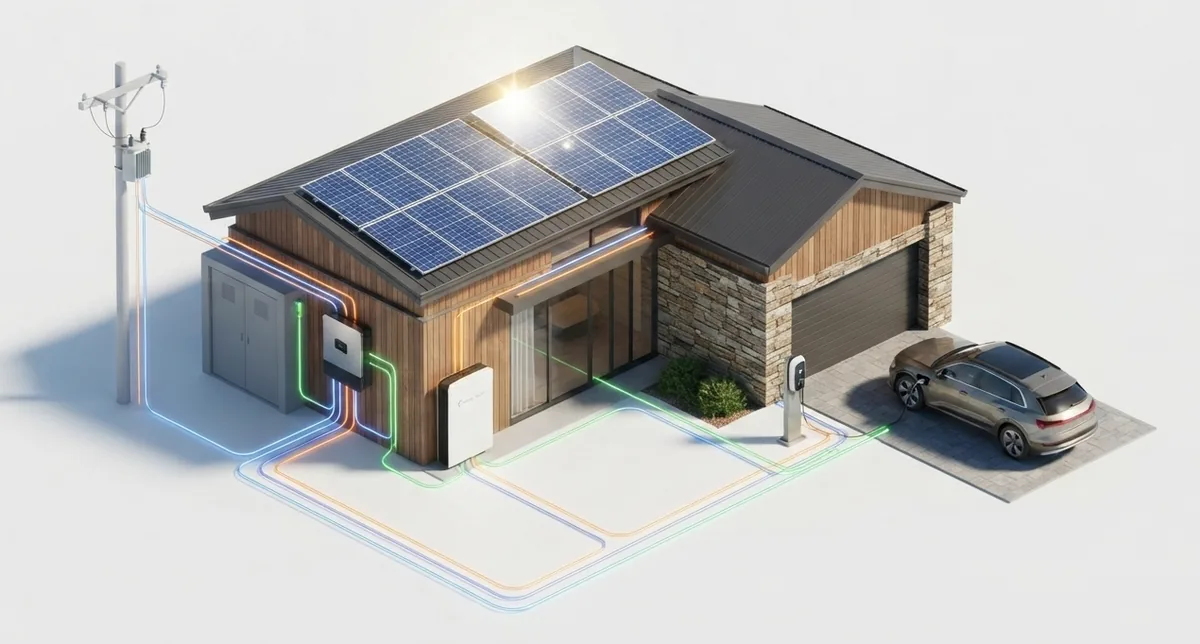
Many faces are the opportunity and the complication. A contemporary two-storey roof typically offers four or more usable planes. That is what makes the orientation choice real. It also means the usable area on any single face is modest. So a larger array is spread across several, with the string design following.
The house shades itself. Many have a lower rear or garage roof. The upper storey can shade part of that lower plane for much of a winter morning. It is measured on site rather than assumed from an aerial image. It is one of the most commonly missed items in a desktop design.
There is little mature shading now, and that will change. Street trees and garden planting here are young. Where a northern or western neighbouring lot is still single-storey, ask what is permissible there. Do that before committing a large array to that side.
Heat matters, because this is western Sydney. Panels are rated at a cell temperature of 25°C. Output falls as the cell rises above it. Inverters also reduce their own output when they overheat. So the inverter position is a design decision. It goes out of direct afternoon sun, with airflow around it, and not boxed into an unventilated cupboard.
Estate covenants apply here. Releases of this era commonly carry restrictions registered on the title. Those include covenants on external appearance, which can bear on street-facing panels. They are a private arrangement rather than a council matter. They are still enforceable. So they are checked against the lot before the layout is fixed. That matters here, because the front face is sometimes the one the orientation analysis points to.
Batteries in The Ponds
A battery is sized against evening and overnight consumption, not against the size of the array. The useful figure is what the household actually uses after dark. Your bills and meter data answer that better than any estimate.
Storage and a west-facing array solve overlapping problems, which is worth knowing before buying both. Both aim to put energy into the late afternoon and evening. If a west array already covers much of your peak, the battery can be smaller. That is a cheaper outcome, not a lesser one.
A smaller battery that is actually cycled every day beats a large one that is rarely emptied.
Where a battery is being retrofitted, the inverter decides most of the cost. Adding storage counts as an upgrade, which brings the connection under current requirements. So an inverter that is not CSIP-AUS approved turns an addition into a replacement plus an addition.
The federal battery discount is applied by the installer at the point of sale. It runs through the small-scale certificate mechanism, and the rate steps down over time. Crown Solar sets out the figure applying to your quote in writing.
Approvals: Blacktown City Council and the NSW planning rules
The Ponds falls within Blacktown City Council. For most rooftop installations the council is not the approval authority. Most rooftop solar in NSW is exempt development under State Environmental Planning Policy (Transport and Infrastructure) 2021. It requires no development application.
The exemption is conditional. A capacity limit and a restriction on panels facing the street are among the conditions. A proposal that does not meet every one of them requires development consent instead. That street-facing condition comes up more often here than you would expect. On an estate lot the best-oriented face is sometimes the front one. It is answered before the design is set, rather than afterwards. Crown Solar checks the lot before the quote is finalised.
What the installation actually involves
When you use power. Twelve months of consumption, split between daytime and after dark, plus your tariff. Together they decide which faces the array should use.
Site assessment. Every usable face with its orientation and pitch. Winter shading, including shade cast by the house itself, and likely future overshadowing. The inverter position chosen for temperature as well as cable run.
Roof and switchboard check. Expected to be straightforward at this age, and confirmed rather than assumed.
Title check on the lot. Any registered covenants, particularly where a street-facing face is proposed.
Design and quote. Layout by face with the orientation reasoning stated. The string design follows it. The export arrangement is the February 2027 phase.
Connection application to Endeavour Energy. Nothing is installed before approval.
Commissioning, metering and handover paperwork.
Find out what your roof can carry
The design starts with your roof and your own bill, not with a number over the phone.
Crown Solar does not quote off a template or over the phone. Every design is built on your own site data.
Common questions about solar in The Ponds
Should I wait for February 2027?
Generally not. Most of the value of a solar system is in the energy you use yourself. The energy you export matters less, and while exports are capped that is more true again. Insist on the arrangement being stated in writing on the quote.
My installer only offered the north face. Is that wrong?
Not wrong, but incomplete if nobody asked when you use power. On a roof with four usable faces that is a decision worth making rather than defaulting. Ask what a north-and-west split would look like for your consumption.
What should I ask every installer who quotes me?
Which faces carry the panels, and why. What consumption pattern and tariff that choice was based on. How the string design handles faces at different orientations. And whether the title permits a street-facing array, if one is proposed.
What Crown Solar installs here
The panel Crown Solar is currently installing is Trina Solar, fitted as the high-wattage Vertex range. On the local record Jinko Solar is the panel on the roofs on file in The Ponds. It appears on more than one of them, from the earlier years of this work. That distinction is worth having if you are comparing a quote against a neighbour's. The panel on your quote is the current one, not the one on their roof. Crown Solar also installs JA Solar, AE Solar and LONGi panels.
Inverters and storage
GoodWe appears on the recorded inverters in The Ponds.
Crown Solar also installs FoxESS, Sungrow, Fronius and SAJ inverters. The batteries are Tesla Powerwall, Sigenergy and AlphaESS. On an array split across orientations, the inverter and string arrangement are part of the same decision. So they are settled with the layout rather than after it. Those are the current range, available on any job, not a list of what has been fitted locally.
Talk to Crown Solar about your home in The Ponds
Crown Solar is a NSW electrical contractor, licence 378172C, and a New Energy Tech Approved Seller. The office is at 3B/4 Louise Avenue, Ingleburn, and is open Mon–Fri 9am–5pm.
For a quote on an address in The Ponds, call 1800 38 50 38. Or email info@crownsolar.com.au, or use the contact form.
Get it in writing for your The Ponds address
Send the address and your last four quarterly bills. You get a system size, the roof faces it sits on, the export arrangement, and the price. All in writing.
Prefer email? info@crownsolar.com.au. One question to start with: what is your place using in a quarter?