Solar and battery installation in Bass Hill
Most solar advertising leads with the feed-in tariff. It is the least important number in the calculation, and this page explains what actually determines what a system saves you.
Solar in Bass Hill: the feed-in tariff is the wrong number to shop on
Bass Hill accounts for three completed Crown Solar installations. One carries a recorded system size, at 10.4kW. A single record is not a local figure and this page will not present it as one.
Bass Hill sits about 23 kilometres south-west of the Sydney CBD in the City of Canterbury-Bankstown, with a little over 10,000 residents at the 2021 census and housing that is largely single-storey post-war, with some low-rise units.
With thin local data, the useful thing this page can do is explain the number that dominates solar advertising and deserves to dominate it least: the feed-in tariff.
Why self-consumption is worth several times export
Every kilowatt-hour your system produces does one of two things. You use it in the house, or you send it to the grid.
A kilowatt-hour you use yourself saves you the full retail rate you would otherwise have paid for it. A kilowatt-hour you export earns the feed-in rate, which is typically a fraction of the retail rate. The gap between those two numbers is the single most important fact in residential solar economics, and it means a unit consumed at home is worth several times a unit sold.
So the design should chase your consumption, not the tariff. That is why nearly every page on this site talks about splitting your usage between daytime and after dark, and why storage, orientation and sizing all come back to the same question: how much of what you generate can you actually use?
What that means in practice. Shifting a load into daylight. Running the dishwasher, the washing machine or the pool pump in the middle of the day instead of at night. Converts an exported unit into a consumed one, and that conversion is worth more than any tariff you could negotiate. It costs nothing but a timer and a habit.
How to read a retail plan properly
A high feed-in rate is not a good plan. It is one line of a plan. Retailers that advertise a strong feed-in rate frequently pair it with a higher daily supply charge, a higher usage rate, or a cap on how many kilowatt-hours a day attract the headline rate.
You buy more than you sell, in almost every household, across the year. So a plan that gives you a little more for what you export and charges you more for what you import can easily leave you behind.
Compare on total annual cost, using your own usage. Your bills carry the figures. Most comparison tools let you enter them. The number worth comparing is what each plan would have cost you over the last twelve months, not the feed-in rate in the advertisement.
And check the tariff structure, not just the rates. If you are on a time-of-use tariff with a peak period in the late afternoon, that changes which roof faces are worth using and whether storage pays. Both of which are design decisions, not retail ones.
None of this is advice about which retailer to choose, and this page does not recommend one. It is the method for working it out yourself, which is more durable than any rate that will have changed by next year.
Your grid connection: Ausgrid, postcode 2197
Bass Hill is on the Ausgrid network, not Endeavour Energy. No Bass Hill job on Crown Solar's record carries a meter identifier, so this page is explicit about the basis: every Crown Solar job across this part of south-western Sydney that does carry one, Bankstown, Condell Park, Revesby, Padstow and Roselands, shows an Ausgrid prefix. Confirm it from your own meter identifier, which settles it in one look.
This matters because the flexible export dates being discussed across south-western Sydney, 2 November and 30 November 2026, are Endeavour dates. They are not Bass Hill's. A quote citing them has been prepared against the wrong network.
What is actually happening on Ausgrid
From 23 November 2026 Ausgrid launches the first release of Ausgrid Connect for embedded generation applications, a new system with a new sign-in. Other application types continue through the existing process for the time being.
On exports, Ausgrid offers a choice between a flexible export connection, which permits the maximum export, and a fixed export connection, which is constantly lower. Ausgrid does not publish the kilowatt figures on its connection page and this site will not guess at them. Ask for the limits that will apply at your address in writing as part of the quote.
That connects directly to the first half of this page. If your export limit is low, the case for self-consumption and storage strengthens further, because exporting is not merely worth less. Past the limit it is worth nothing.
The NSW-wide requirements, which do apply here
From November 2026, new requirements are being phased in for all new and upgrading solar systems in NSW. A smart solar inverter capable of responding to an emergency backstop, registration in the NSW Government's CER Installer Portal, and an internet connection communicating securely with network systems.
Ausgrid also says plainly to always use a Solar Accreditation Australia (SAA) accredited installer, and that you should receive a Certificate of Compliance for Electrical Work after installation. Keep it. You will want it when you sell the house.
What Bass Hill properties mean for system design
Post-war single-storey housing, which helps in two ways. A single-storey roof is safer and quicker to work on and gives better access to the full roof plane, so access and scaffolding cost less than on a two-storey house.
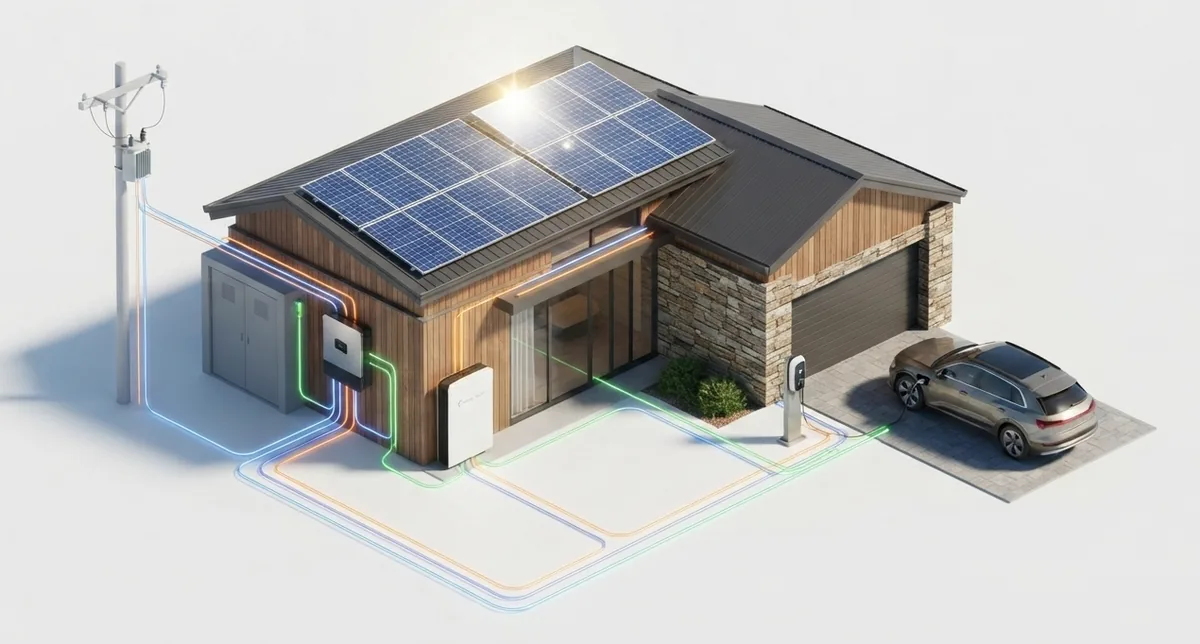
Switchboard age is the recurring cost. A board of this era frequently needs replacement or upgrade before a battery, in capacity, protective devices and physical space. It should be assessed and priced before you sign rather than raised on installation day. Two quotes that look far apart frequently differ on exactly this line.
Asbestos in a pre-1990 house is a constraint to plan for, not a scare. Bonded asbestos cement sheeting was used in Australian housing until the late 1980s, including eaves linings, meter box backing boards and some wall sheeting. Where it is present it changes how cable is run, where penetrations can be made and who may do that work. The eaves and meter box are inspected during the site assessment rather than discovered with a drill.
Roof condition decides the sequence. Where a roof is close to needing replacement or significant repair, doing that first and the solar second is cheaper than paying to remove and refit an array later. The roof is assessed at quote stage.
Usable faces, not total roof area. A post-war hip roof divides into four modest faces, and the north and west area that can carry panels is normally about half what the roof looks like from the street.
Winter shading from decades of garden growth. A tree that casts nothing on the roof in January can cover a significant part of an array at nine in the morning in June, because the sun is roughly thirty degrees lower. Shading is assessed for the winter sun path rather than from how the roof looks on the day of the visit.
If you are in one of the low-rise unit blocks, the roof is common property. The owners corporation decides, not an individual lot owner. The Bankstown page sets out that process; start with your strata manager rather than with quotes.
Batteries in Bass Hill
A battery is sized against evening and overnight consumption, not against the size of the array. The useful figure is what the household actually uses after dark, which your bills and meter data answer better than any estimate.
Everything in the first half of this page points at storage, because a battery is the most direct way of converting exported units into consumed ones. Whether it pays depends on the size of your after-dark load and on the gap between your retail rate and your feed-in rate, which is an arithmetic question your own bills can answer.
A smaller battery that is actually cycled every day beats a large one that is rarely emptied. Oversized storage is an expensive way to feel prepared.
Where a battery is being retrofitted, the inverter decides most of the cost. Adding storage is treated as an upgrade, which brings the connection under current requirements, so an inverter that cannot respond to the emergency backstop turns an addition into a replacement plus an addition. On housing of this age the switchboard often sits on the same critical path.
The federal battery discount is applied by the installer at the point of sale through the small-scale certificate mechanism, and the rate steps down over time. Crown Solar sets out the figure applying to your quote in writing rather than publishing one here.
Approvals: City of Canterbury-Bankstown and the NSW planning rules
Bass Hill falls within the City of Canterbury-Bankstown. For most rooftop installations the council is not the approval authority, because most rooftop solar in NSW is exempt development under State Environmental Planning Policy (Transport and Infrastructure) 2021 and requires no development application.
The exemption is conditional, with a capacity limit and a restriction on panels facing the street among the conditions, and a proposal that does not meet every one of them requires development consent instead. It also carries limits on land with heritage significance, and the council maintains a heritage schedule. Crown Solar checks the lot before the quote is finalised.
What the installation actually involves
Network confirmed from your meter identifier, because the record here does not carry one and the export rules follow from it.
Tenure. House or strata, because in a scheme the roof is common property.
Twelve months of consumption. Split between daytime and after dark, which is what the whole economics rests on.
Site assessment. Roof material, pitch, age and condition, usable faces, winter shading, and the inverter position with its internet coverage.
Switchboard, meter box and eaves. Condition, capacity, and whether pre-1990 sheeting is present.
Design and quote. Layout by roof face, array sized against daytime use, battery against overnight use, and the Ausgrid export arrangement in writing.
Connection application to Ausgrid, submitted by your installer.
Commissioning, metering and handover paperwork, including the Certificate of Compliance for Electrical Work.
Find out what your roof can carry
The design starts with your roof and your own bill, not with a number over the phone.
Crown Solar does not quote off a template or over the phone. Every design is built on your own site data.
Common questions about solar in Bass Hill
Should I wait for the November network changes?
No, and the question partly rests on a mix-up: the staged November dates belong to Endeavour Energy, which is not your network. What applies from November is the NSW-wide equipment and registration requirement, satisfied by using compliant equipment now rather than by waiting.
An installer quoted me a payback based on the feed-in tariff. Is that wrong?
It is incomplete, and usually optimistic in the wrong direction. A payback built mostly on export income assumes you will sell most of what you make, which is the least valuable thing you can do with it. Ask what share of generation the calculation assumes you consume, and where that share came from.
What should I ask every installer who quotes me?
Which network they have quoted against, what export limit will apply at your address in writing, what daytime consumption figure the array size came from, and whether the switchboard was inspected and priced or merely assumed.
What Crown Solar installs here
The panel Crown Solar is currently installing is Trina Solar, fitted as the high-wattage Vertex range. On the local record Eging is the panel on the Bass Hill roof on file, from the earlier years of this work. That distinction is worth having if you are comparing a quote today against what a neighbour had fitted: the panel on your quote is the current one, not the one on their roof. Crown Solar also installs JA Solar, Jinko Solar, AE Solar and LONGi panels.
Inverters and storage
Crown Solar installs FoxESS, Sungrow, Fronius, GoodWe and SAJ inverters, and Tesla Powerwall, Sigenergy and AlphaESS batteries. Which one suits depends on whether you want whole-home backup, whether you expect to expand later, and whether you intend to join a virtual power plant, and those are three genuinely different conversations rather than three names for the same product. Those are the current range, available on any job, not a list of what has been fitted locally.
Talk to Crown Solar about your Bass Hill home
Crown Solar is a NSW electrical contractor, licence 378172C, and a New Energy Tech Approved Seller. The office is at 3B/4 Louise Avenue, Ingleburn, and is open Mon–Fri 9am–5pm.
For a quote on a Bass Hill address, call 1800 38 50 38, email info@crownsolar.com.au, or use the contact form.
Get it in writing for your Bass Hill address
Send the address and your last four quarterly bills. You get a system size, the roof faces it sits on, the export arrangement, and the price. All in writing.
Prefer email? info@crownsolar.com.au. One question to start with: what is your place using in a quarter?